Kettlebell training for women: loading, not lightening

Contains affiliate links. Our policy.
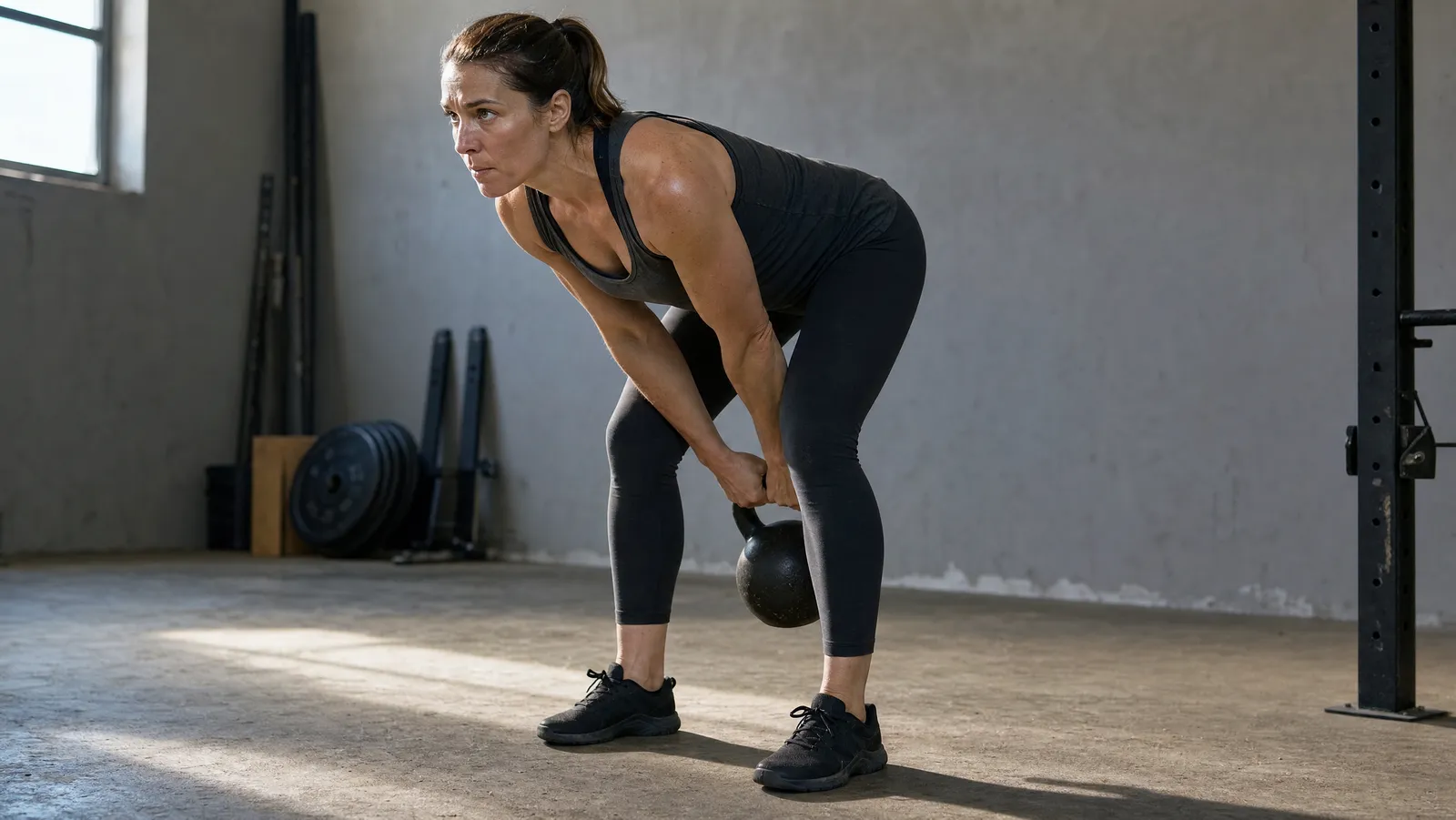
Kettlebell training for women is the same training as everyone else's: the same six movements, the same programming logic, the same progression rules. The most common mistake is not technique. It is a first bell chosen to look unintimidating rather than to be useful — light enough that nothing in the body has to change in response to it.
The industry default is 8kg (18lb) for a woman and 16kg (35lb) for a man, and we have found no trial validating either number. What the research supports is less tidy and more useful: load is a property of the movement, not of the lifter's sex, and almost nobody of any sex should own only one bell. If you are starting from nothing, our kettlebell training guide for beginners covers the implement, the patterns and the safety basics. This page is about load — and about the one place where a lighter bell genuinely is the right answer.
One caution before any of it. Kettlebell ballistics load the lower back in a way most lifts do not — McGill and Marshall measured a posterior shear of L4 on L5 during the swing that is "opposite in polarity to a traditional lift". If you have a history of back or shoulder pain, are pregnant or recently postpartum, or are managing a diagnosed bone condition, the first step is an individual assessment rather than a plan off the internet.
Why the lighter bell became the default
Two reasons, and neither of them is evidence. The first is marketing: in our reading, toning was never a physiological category, it was a way to sell resistance small enough to be unthreatening and small enough that it caused little adaptation. The pink 5lb dumbbell is the clearest artefact of that era, and the 8kg kettlebell inherited its logic.
The second is that fewer women were lifting at all, so the market never had to get the load right. CDC's National Center for Health Statistics reported that in 2020, "35.2% of men and 26.9% of women" aged 18 and over "met the federal guideline for muscle-strengthening physical activity." A product category aimed at people who are mostly not training yet gets sold on reassurance rather than on specification.
Where women's strength actually differs — and where it does not
Mostly in the upper body, and the gap looks like a matter of how much tissue is where, not of what the tissue can do.
The cleanest published figure we found is old and small. Miller and colleagues, in the European Journal of Applied Physiology and Occupational Physiology, measured strength and muscle characteristics in the biceps brachii and vastus lateralis of eight men and eight women and reported that "The women were approximately 52% and 66% as strong as the men in the upper and lower body respectively." Their explanation for the asymmetry is in the same abstract: "The greater gender difference in upper body strength can probably be attributed to the fact that women tend to have a lower proportion of their lean tissue distributed in the upper body."
The same paper is the reason to stop short of any conclusion about capacity: "No significant gender difference was found in the strength to CSA ratio for elbow flexion or knee extension", and "the greater strength of the men was due primarily to larger fibers." Read the limits before using those percentages for anything — eight people per group, two muscles, published in 1993. Treat 52 and 66 percent as the shape of a finding, not a number to programme against.
The practical consequence is this whole article: the bell that is correct for your swing and your goblet squat is usually too heavy for your overhead press, and the bell that is correct for pressing is far too light to swing. That is not a women's problem; it is true of almost every beginner. What differs is that a woman is far more likely to be sold only the light one and told it is complete — so a light bell is not wrong, it is wrong as the only bell. That reframing is our editorial judgement applied to the strength data above, not a published finding.
On adaptation rather than baseline, the sex difference mostly disappears. The 2021 systematic review and meta-analysis by Jones and colleagues in Sports Medicine pooled 30 studies and 41 comparison groups — 1,410 participants over 50 years old, 651 men and 759 women — all performing identical resistance training. Females "gained more relative lower-body strength than males", with "no differences in relative change for upper-body strength" or "relative muscle size", while "Males gained more absolute upper-body strength", absolute lower-body strength and absolute muscle size. That is also the only sentence this article will spend on the bulk question: relative size change did not differ, absolute size gains favoured the men.
Read the limits. Everyone in that review was over 50, mean study quality was "14.7/29 on a modified Downs and Black checklist, considered moderate quality", and the authors flag the framing problem themselves: interpretation "is heavily influenced by the presentation of the results in either an absolute or relative context."
What weight should a woman start with?
The honest answer to kettlebell weight for women beginners is that it depends on the movement, and that the number you want is two numbers.
We are not going to publish a second, contradictory set of figures here. Our position is set out in what size kettlebell to start with, and it does not change by sex: buy for the press, because the press sets the ceiling — for most adults 8kg (18lb) to 12kg (26lb), and 6kg (13lb) is not a failure — then add a hinge bell in the 12kg (26lb) to 16kg (35lb) band if the budget stretches.
The trial protocols were lighter than the shops too, and they did not split loads by sex. The BELL pragmatic controlled trial by Meigh and colleagues in BMC Geriatrics recruited "Insufficiently active men and women aged 59-79 years" — sixteen of each — and issued every participant "an 8 kg kettlebell (provided)" for home training, with heavier bells "roughly distributed based on physical capacity i.e., the stronger participants received heavier kettlebells." Grip strength across the cohort rose 7.1kg in the right hand. Read the limits the authors state: the design has validity problems "particularly with respect to the absence of blinding and lack of a separate control group."
Two tests tell you more than any chart.
| Movement | How to test it | Where most beginners land | |---|---|---| | Half-kneeling one-arm press | Eight clean reps, ribs down, no back arch to finish | 6kg (13lb) to 12kg (26lb) | | Two-hand swing | Ten reps where the bell floats and the hips, not the arms, move it | 12kg (26lb) to 16kg (35lb) |
If your spine finishes the press, the bell is too heavy, and no amount of wanting it changes that. If the swing bell feels weightless and your breathing does not change, it is too light to be training anything. When the two tests disagree — and they will — the answer is not a compromise weight in the middle. It is the argument for two bells, which is what whether one kettlebell is enough works through in detail.
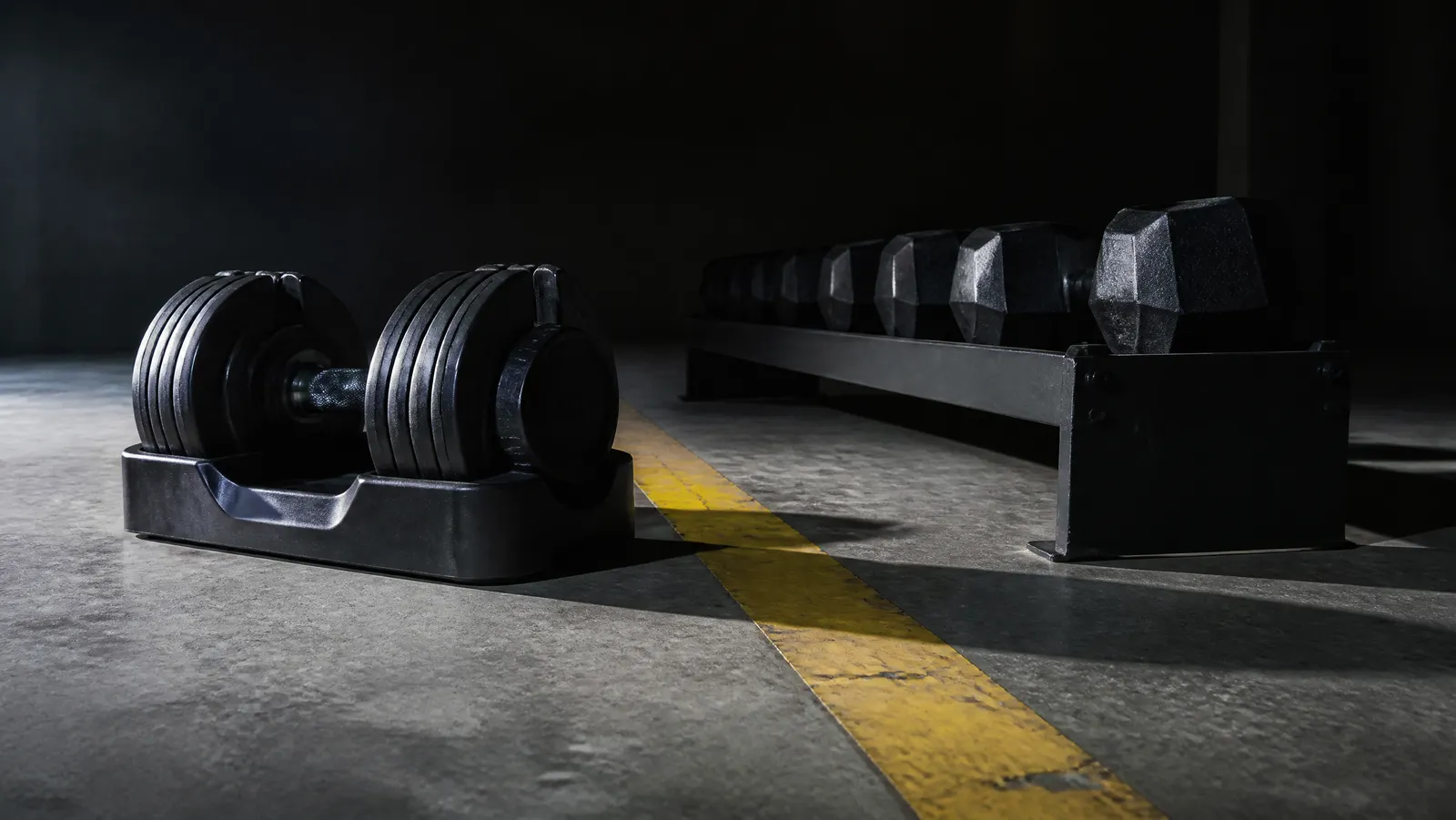
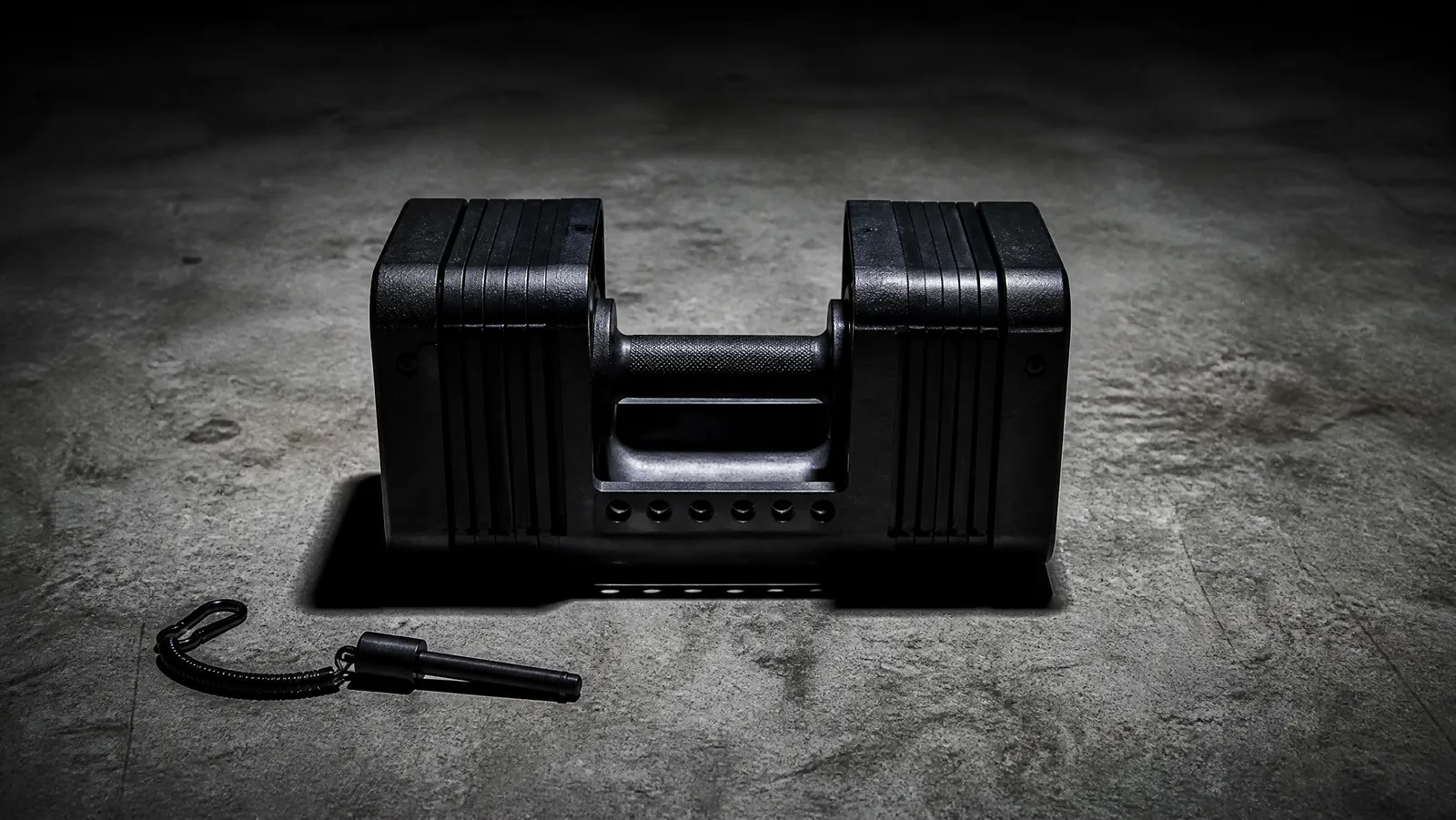
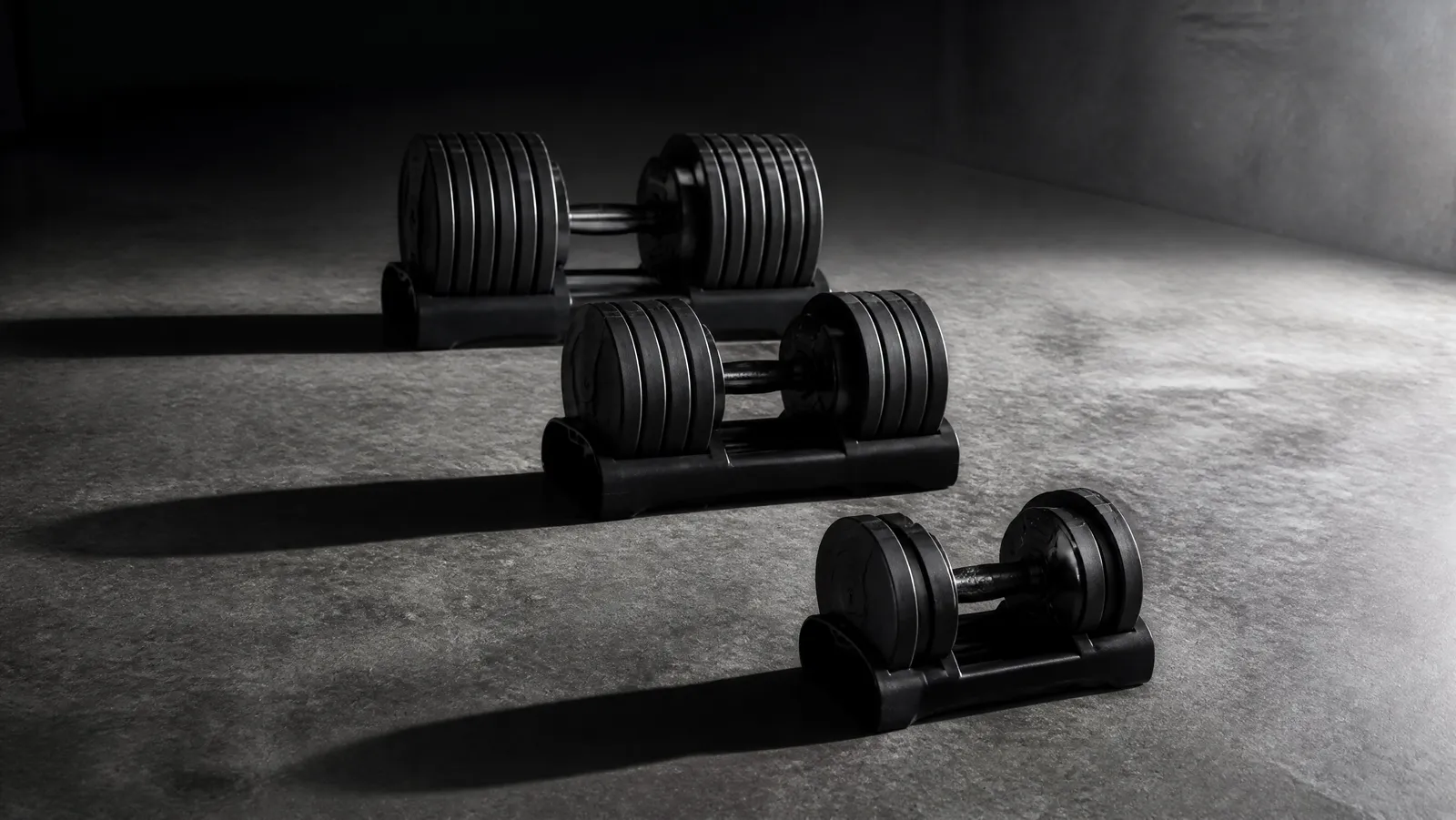
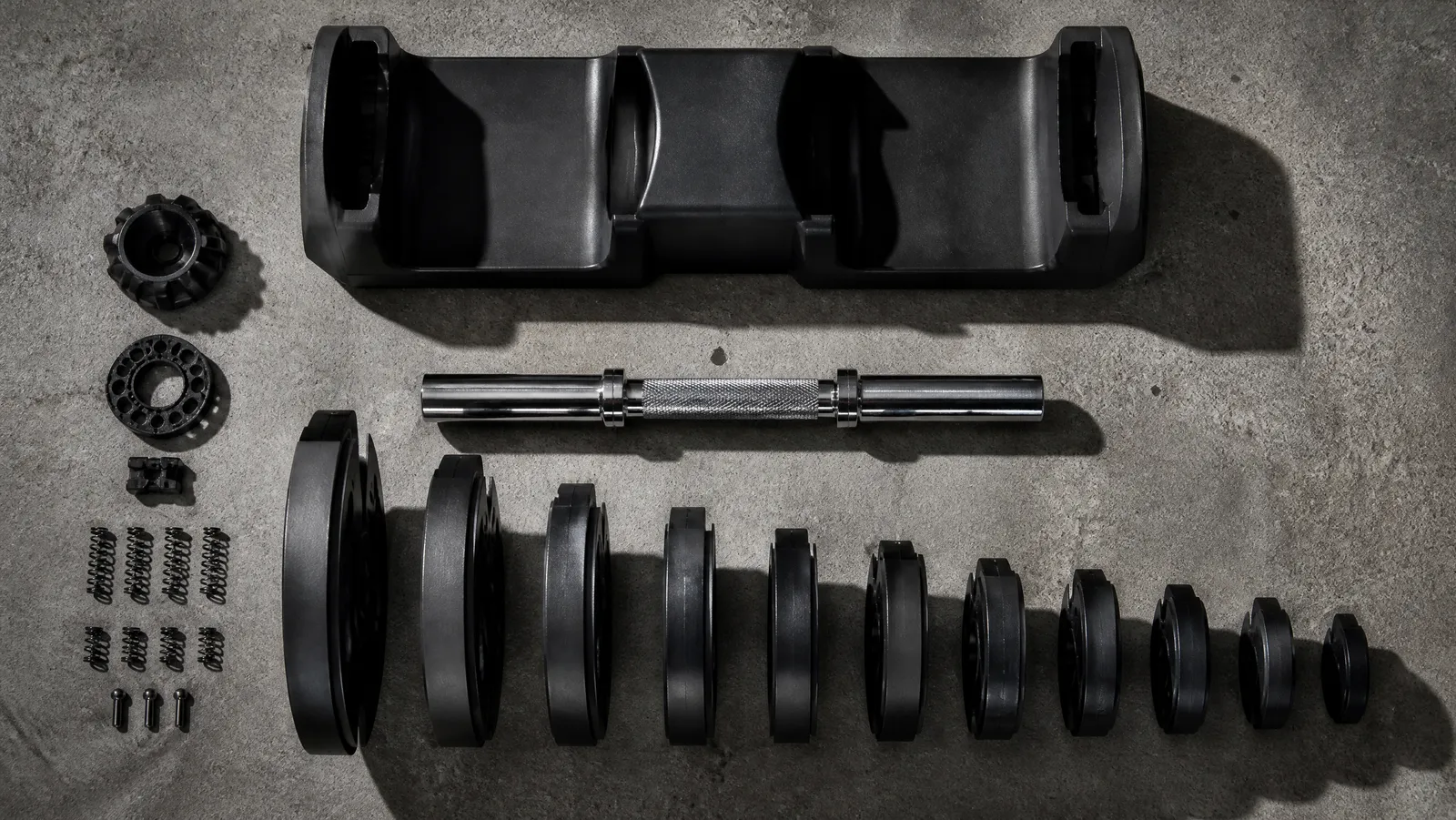
Adjustable bells are the obvious objection, and they do solve the arithmetic. Our reservation is handle feel and the confidence to let go of a bell mid-swing; we have not tested them against fixed bells and will not pretend otherwise.
The exercises are the same exercises
There is no separate women's movement list. The answer to kettlebell exercises for women is the same six we would give anyone: the deadlift, the two-hand swing, the goblet squat, the half-kneeling one-arm press, the one-arm row and the loaded carry. The six kettlebell exercises worth learning first is the full treatment, and we would not change a line of it by sex.
What does differ in practice is narrower than the internet suggests, and it is mostly about load and about hands.
- The press needs a progression the hinge does not. Given the upper-body figure above, the lightest bell that is genuinely useful for a swing can still be a hard press for months. The fix is more reps and more sets on the press — not a lighter swing, and not dropping the press from the week.
- Handle thickness is a real variable and a badly documented one. Competition-bell makers specify one handle diameter across every weight, and cast-iron bells generally get thicker as they get heavier, so the bell you can hinge may be a bell your hand cannot hold for ten reps. We found no study on handle diameter, hand size and grip in women, so treat this as mechanical reasoning rather than evidence: grip, not the hips, can be what ends a swing set.
- Load selection is the only thing worth individualising. Same six patterns, same order, same cues. Different bell on the press than on the hinge.
Anyone selling you a women's kettlebell workout that differs in its movement list is selling you a lighter version of the house programme with new names.
Bones, menopause and the case for loading properly
This is the section where lightening stops being merely ineffective and starts costing something.
NIAMS sets out the baseline plainly: "Women have lower peak bone mass and smaller bones than men", and for many women "the disease begins to develop a year or two before menopause", with "Low estrogen levels in women after menopause" among the listed causes.
The strongest trial we found on loading against that curve is LIFTMOR. Watson and colleagues in the Journal of Bone and Mineral Research randomised 101 postmenopausal women with low bone mass (T-score below -1.0, mean age 65) to eight months of "twice-weekly, 30-minute, supervised HiRIT" at "5 sets of 5 repetitions" above 85 percent of one-repetition maximum, or to a home-based, low-intensity programme. Lumbar spine bone mineral density rose 2.9 percent in the training arm against a 1.2 percent fall in the controls. Femoral neck density rose 0.3 percent against a 1.9 percent fall. The trial recorded "only one adverse event reported (HiRIT: minor lower back spasm, 2/70 missed training sessions)." The authors' own framing: "Contrary to current opinion, HiRIT was efficacious and induced no adverse events under highly supervised conditions for our sample of otherwise healthy postmenopausal women with low to very low bone mass."
Now read the limits, because they are large and they point straight at this article's subject.
- It was not a kettlebell programme. The published prescription is five sets of five above 85 percent of one-repetition maximum. We have found no trial testing kettlebell training specifically against bone density outcomes in postmenopausal women, so applying LIFTMOR to a bell is an inference from adjacent resistance-training research, not direct evidence.
- It was highly supervised. The authors attach that condition to their own safety claim. A garage floor is not a research gym.
- It studied otherwise healthy postmenopausal women with low bone mass for eight months. It is not a result about a 34-year-old, and it is not a prescription for anybody.
What it does establish is the direction of the usual error. The default advice to postmenopausal women has been to go lighter; in this trial the group that went heavy gained bone at the spine while the group that stayed light lost it. NIAMS's exercise guidance is consistent at lower resolution — resistance exercises "put stress on bones, so they can make bones stronger as well."
And then the hard line. If you have a diagnosis of osteopenia or osteoporosis, this page is not your programme. NIAMS's instruction for people with low bone density is to "talk to a health care provider before starting an exercise program", and that is the correct next step. An individualised plan from a clinician who has seen your scan beats any article, including this one.
Direct kettlebell evidence in women exists, small and in an older population. Chen and colleagues, in Experimental Gerontology, randomised 33 women aged 65 to 75 with sarcopenia to eight weeks of kettlebell training — 60-minute sessions twice a week — or to no training. Their conclusion: "For elderly people with sarcopenia, participating in kettlebell training significantly increases the sarcopenia index, grip strength, back strength, and PEF." The limits are obvious: 33 participants, eight weeks, a population with diagnosed sarcopenia, and no bone density measurement at all.
Pregnancy, postpartum and the pelvic floor
We will not programme this, and you should be sceptical of any gear site that does.
The general guidance is encouraging. ACOG Committee Opinion Number 804 states that "In the absence of obstetric or medical complications or contraindications, physical activity in pregnancy is safe and desirable, and pregnant women should be encouraged to continue or to initiate safe physical activities." The same document is equally clear that "some modification to exercise routines may be necessary because of normal anatomic and physiologic changes and fetal requirements."
Which modifications, and whether a loaded ballistic hip hinge is among them, is not something an article can decide for an individual pregnancy. That decision belongs with your obstetric provider or a pelvic health physiotherapist. We are not publishing a trimester plan, a weight, or a return-to-training timeline, and we found no trial of kettlebell training in pregnancy to publish one from.
On the pelvic floor the evidence is genuinely two-sided, and it is worth knowing in both directions.
The association shows up clearly in observational data. The 2025 systematic review by Alves and colleagues in the International Urogynecology Journal included five studies and 1,809 participants in its qualitative synthesis and reported that "The prevalence of urinary incontinence (UI) in powerlifters ranged from 41.0% to 48.8% and in weightlifters from 36.6% to 54.1%." The deadlift "was the exercise most commonly associated with UI (42.5%), followed by squats (36.3%)", and "The main associated factors were age, parity, and body mass index."
The acute mechanism did not appear when somebody measured it directly. Skaug, Engh and Bø, in Medicine and Science in Sports and Exercise, put 47 nulliparous strength-trained women aged 18 to 35 through either 60 minutes of weightlifting — "four sets of four repetitions at 75%-85% of 1RM in back squat and deadlift" — or 60 minutes of seated rest, in a crossover design. The result: "No statistically significant differences were found when comparing the change in PFM resting pressure, strength, endurance, and resting activity after heavy weightlifting and rest." Their conclusion is carefully bounded: "Our results imply that heavy weightlifting is well tolerated by the PFM in short term among young, nulliparous, and strength-trained women."
Put those honestly side by side: incontinence is common among women who lift heavy, a single heavy session did not measurably change pelvic floor function in young women who had not given birth, neither design can tell you which way the causation runs, and neither used kettlebells.
What that leaves is a symptom rule rather than a programme. Leaking during swings or presses, visible doming along the midline of the abdomen under load, or a feeling of heaviness or pressure in the pelvis are reasons to stop the set and get assessed by a pelvic health physiotherapist. They are not reasons to accept a permanently lighter bell for life, and not conditions this article will hand you exercises to fix.
Building the habit
Frequency first, load second, and the frequency number is small.
ACSM's summary of its 2026 position stand on resistance training prescription recommends "Training all major muscle groups at least twice a week", with loads of 80 percent of one-repetition maximum across two to three sets per exercise for maximum strength, and for growth it says to "Aim for higher weekly volume (~10 sets per muscle group)."
Two to three sessions a week is where our beginner plan sits, and kettlebell workouts for beginners is the four-week on-ramp we would actually run: five movements, written-down sets and reps, and a progression that moves reps and density before it moves the bell.
Progress is the thing a too-light bell quietly steals. Kettlebells do not come in small increments, so for weeks at a time your variables are reps, sets, tempo and rest. That works from a load that was honest to begin with. From a bell chosen to be unintimidating, you spend the first month adding reps to something that was never hard, then conclude kettlebells do not do much.
What we would actually do
Buying one bell: choose it with the press test rather than a chart, and accept that it will feel trivially light on swings for a fortnight. Buying two: let the light bell own presses, rows and carries, and the heavier one own hinges and squats. Postmenopausal: the strongest evidence here is that loading properly is the point, and the strongest caveat is that we have found no trial testing kettlebells specifically against bone outcomes. A diagnosis, a pregnancy, a recent birth, or symptoms under load: start with a clinician, not with a weight.
The thesis in one line: the problem with kettlebell training for women was never that the movements are wrong. It is that the load keeps getting chosen to reassure rather than to work.
For the rest of the map — what the implement is for, which exercise comes first, how a week fits together — go back to Exercise Legend's kettlebell guide.
What to know before you buy
Field Notes
What weight kettlebell should a woman start with?
Pick it with a movement test rather than a chart. Our position, set out in full in our starting-weight guide, is to buy for the press first: a bell you can press eight clean times from a half-kneeling position without your lower back arching to finish the rep, which for most adults lands between 8kg (18lb) and 12kg (26lb). The research protocols were lighter than the shops and did not split loads by sex. The [BELL pragmatic controlled trial by Meigh and colleagues in BMC Geriatrics](https://pmc.ncbi.nlm.nih.gov/articles/PMC9026020/) recruited "Insufficiently active men and women aged 59-79 years" — sixteen of each — and gave every participant "an 8 kg kettlebell (provided)" for home training, with heavier bells "roughly distributed based on physical capacity i.e., the stronger participants received heavier kettlebells." Capacity, not sex. Read the limit the authors publish themselves: the design has validity problems "particularly with respect to the absence of blinding and lack of a separate control group," and the cohort was aged 59 to 79.
Will kettlebells make women bulky?
One sourced sentence and then we will move on, because it is a tired frame. The 2021 systematic review and meta-analysis by [Jones and colleagues in Sports Medicine](https://pubmed.ncbi.nlm.nih.gov/33332016/) pooled 30 studies and 41 comparison groups covering 1,410 adults over 50 — 651 men and 759 women — all doing identical resistance training, and found "no differences in relative change for upper-body strength" or "relative muscle size" between the sexes, while "Males gained more absolute upper-body strength", absolute lower-body strength and absolute muscle size. In other words, relative gains were comparable and absolute size gains favoured the men. Read the limits: participants were older than 50, and mean study quality was "14.7/29 on a modified Downs and Black checklist, considered moderate quality". Extending it to a 30-year-old is an inference, not a finding.
Are kettlebell swings safe during pregnancy?
That is a question for your obstetric provider, and we are not going to answer it with a weight or a rep scheme. The general guidance is encouraging. [ACOG Committee Opinion Number 804](https://pubmed.ncbi.nlm.nih.gov/32217980/) states that "In the absence of obstetric or medical complications or contraindications, physical activity in pregnancy is safe and desirable, and pregnant women should be encouraged to continue or to initiate safe physical activities," and that women who were physically active before pregnancy "can continue these activities during pregnancy and the postpartum period." The same document is equally clear that "some modification to exercise routines may be necessary because of normal anatomic and physiologic changes and fetal requirements." Which modifications apply to a loaded ballistic hip hinge depends on the individual pregnancy, so that decision belongs with your obstetric provider or a pelvic health physiotherapist. We found no trial of kettlebell training in pregnancy at all.
Who put in the work
The Coach
Your Coach
Darlene Schmitt
I am a fitness instructor and promoter who truly enjoys helping others become the best they can be! My mission is to help people find the love of fitness and to help them develop a lifelong habit of exercise. I am a firm believer that fitness should be fun, and I make it my mission to ensure that my classes are always enjoyable. I am also a certified nutritionist and personal trainer, so I am able to offer my students comprehensive and well-rounded support.