Are adjustable dumbbells worth it? The honest cost case

Contains affiliate links. Our policy.
Yes, for most home lifters, and one number decides it. The cheapest set we sourced works out at about $1.37 per pound ($3.02 per kg) of top-end load and the dearest at about $4.83 ($10.65 per kg). Cost per pound rises as you spend more, which is the opposite of how iron normally works. We earn a commission on purchases made through links on this page, at no cost to you.
So the money up the range is not buying weight. It is buying the mechanism, the increments and the warranty. That is the whole argument of this page, and the table below is the evidence for it.
We sourced five live sets on 10 November 2026, spanning $54.99 to $869, and divided each price by the total top-end load it puts in two hands. The division is ours. No manufacturer publishes a dollars-per-pound figure, and we would not trust one that did.
Two things you should know before the numbers. We have not tested, lifted or owned any of these sets, so every spec here is the maker's or a named reviewer's and we say which every time. And we quote no star ratings or review counts anywhere on this site, because our product data source returns none, so any number we printed would be invented. If you have not settled on a mechanism yet, adjustable dumbbells for a home gym is the page for that decision. This one is only about the money.
One caution first, because it is the most consequential fact in the category. On 5 June 2025 the US Consumer Product Safety Commission announced recall 25-311, covering about 3,844,200 BowFlex 552 and 1090 adjustable dumbbells, because "The weight plates can dislodge from the handle during use, posing an impact hazard." The notice instructs that "Consumers should immediately stop using the recalled Bowflex adjustable dumbbells." That is the largest of at least eight US recalls of adjustable dumbbells since 2012, and it is why neither of those models appears among our picks. Nothing on this page is medical advice. If you are returning from a shoulder, wrist, elbow or back problem, get assessed by a clinician or a qualified coach before you load anything overhead.
The cost per pound ladder, cheapest pound first
Here is the arithmetic, on live prices as of November 2026. Every dollars-per-pound figure in the last two columns is our calculation, not a published spec.
| Set | Price, Nov 2026 | Top-end load, two hands | Our cost per pound | Mechanism | |---|---|---|---|---| | Yes4All 40lbs pair plus connector | $54.99 | 40 lb (18.1 kg), per the listing title | $1.37 ($3.02 per kg) | spinlock collars | | BDSHE 70lbs 5-in-1 | $113.38 | 70 lb (31.8 kg), per the listing title | $1.62 ($3.57 per kg) | plate-loaded, double nuts | | MouldBody 10-in-1 dial pair | $239.99 | 100 lb (45.4 kg) | $2.40 ($5.29 per kg) | dial selector | | PowerBlock Elite EXP 90 Stage 1 | $399 | 100 lb (45.4 kg) | $3.99 ($8.80 per kg) | pin selector | | PowerBlock Elite USA 90 | $869 | 180 lb (81.6 kg) | $4.83 ($10.65 per kg) | pin selector |
The two cheapest rows are the least trustworthy rows, and we would rather say so than let the ladder look tidier than it is. Both denominators come from a listing title, and on both of those listings the title fights the feature text. We unpick both below. Read the bottom two rows as the best case for cheap sets, not as measured load.
The direction of travel is the finding. A set costing fifteen times as much as the cheapest one costs roughly three and a half times as much per pound of load. Spending more buys you less metal per dollar, every single step up.
Are adjustable dumbbells good value? What the extra money actually buys
Five things, and only one of them is weight.
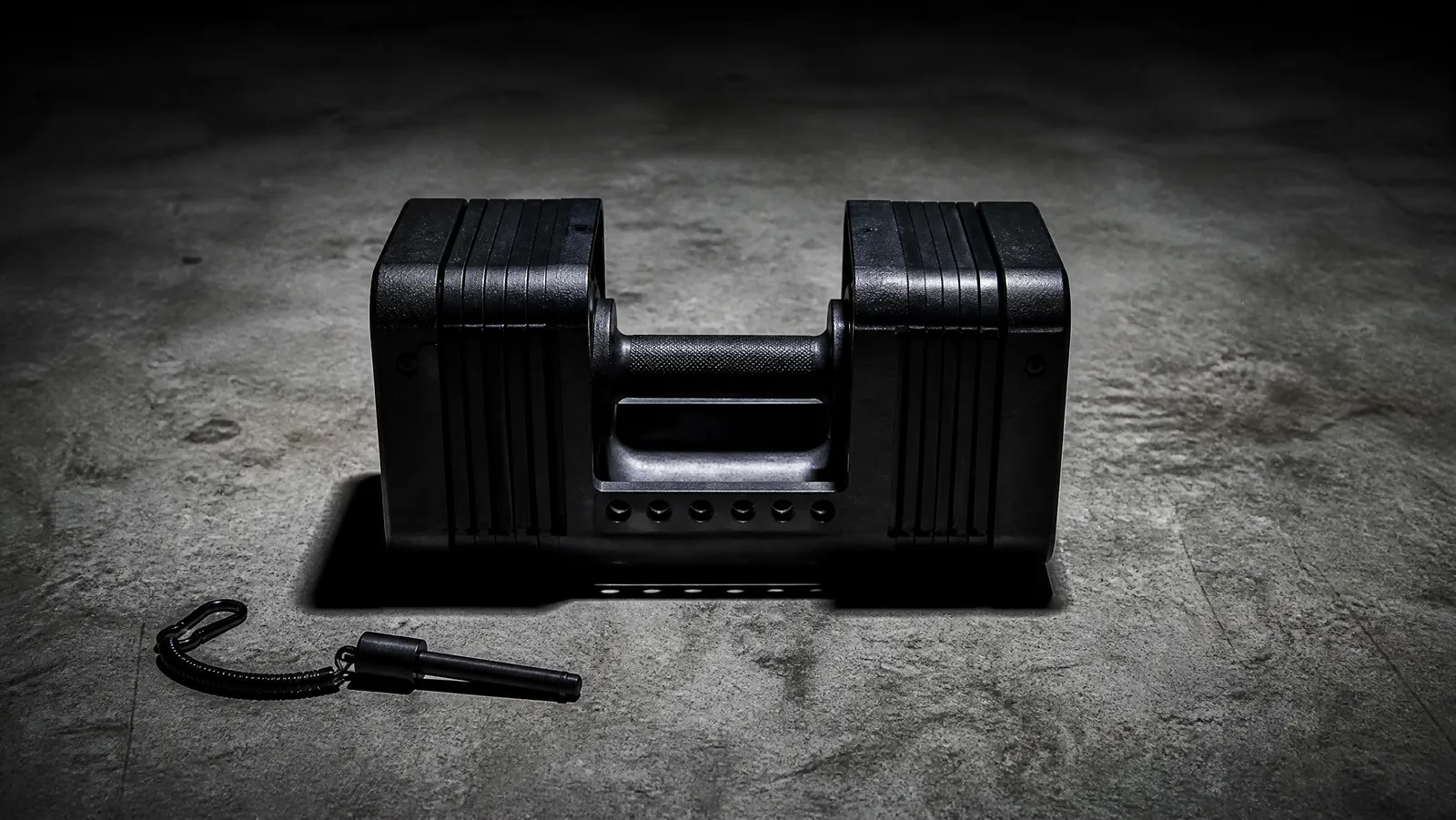
- Mechanism. A spun collar is a nut on a thread and costs almost nothing. A pin selector is a machined cage. PowerBlock's Elite EXP spec sheet describes a "Magnetic selector pin" and a lock that "secures 2.5lb adder weights", and reduces the whole operation to "Just insert pin and lift." You are paying for that sentence.
- Increment granularity. The same sheet publishes Stage 1 settings of 5, 7.5, 10, 15, 17.5, 20, 25, 27.5, 30, 35, 37.5, 40, 45, 47.5 and 50 lb. There is no 12.5 and no 22.5. The MouldBody listing's ladder reads 5.5/11/15/22/25/31/35/41/45/50 lb, which is a kilogram ladder converted into pounds. Cheap plate sets give you whatever pairs of plates you own, which on the Yes4All contents is 5 lb (2.3 kg) and 8 lb (3.6 kg) discs.
- Materials. PowerBlock's sheet specifies "Solid steel plates". The BDSHE listing's own feature text says its plates have an exterior made of cement and iron sand in a PE shell. Those are different products wearing the same category name.
- Warranty. PowerBlock's sheet lists a "5 year limited warranty" across all three stages. PowerBlock's own warranty schedule splits that cover by component, five years on the handle assembly and the weight plates but one year on the selector pin and the micro weights, which is a distinction the spec sheet itself does not draw. Neither of the two cheapest sets we sourced publishes a warranty term in its listing at all.
- Resale. We found nothing publishable. No maker, retailer or test programme we searched publishes resale data for this category, so we are not going to put a number on it.
Our position is that the first four of those are worth real money and the fifth is a hope. Why the dial and pin sets cost what they do, component by component, is the subject of why adjustable dumbbells are so expensive.
The expansion-kit arithmetic, and it is the most useful thing on this page
The PowerBlock Elite EXP 90 is not a 90 lb dumbbell when you buy it. It is a 50 lb one with a 90 in its name.
PowerBlock's own spec sheet lays the staging out in a table: Stage 1 covers a "5- 50 lbs" range, Stage 2 covers "50-70 lbs", Stage 3 covers "70-90 lbs", and each stage has its own part number. Stage 1 alone, which is what $399 buys, tops out at 50 lb (22.7 kg) per hand.
The kits are sold separately. We sourced both live on 10 November 2026 at $199 each, and Target lists the same $199.00 as of November 2026 on its Elite EXP Stage 2 kit and Elite EXP Stage 3 kit pages. Buy the part that matches your family: PowerBlock's own spec sheet gives the Elite EXP Stage 2 kit its own part number, 501-00097-01, and PowerBlock lists separate Stage 2 kits for its other ranges at other prices. Stage 3 also requires Stage 2 to be fitted first, and Target's Stage 3 listing says so plainly: "you will need both the original Elite EXP set and the Stage 2 Expansion Kit."
So the two routes to 90 lb (40.8 kg) per hand price out like this:
- In stages: $399 plus $199 plus $199 equals $797. On our arithmetic that is about $4.43 per pound ($9.76 per kg) of the 180 lb (81.6 kg) you end up with.
- All in, as the Elite USA 90: $869, or about $4.83 per pound ($10.65 per kg).
The gap is $72, and it is a smaller gap than most buyers expect. Our judgement, stated as judgement: if you are confident you will want 90 lb per hand within a few years, the staged route saves $72 and lets you spread it, and that is a genuine win. If you are not confident, buy Stage 1 and stop: $399 for 100 lb (45.4 kg) of usable load is the mid-range buy we would make, even though the dial pair at $2.40 per pound is the cheaper pound.
One trap closes that door, though. PowerBlock's Elite EXP listing states it is not compatible with Elite USA 90 expansions or accessories, and the Elite USA listing says the same thing in reverse. You cannot start on one family and finish on the other. Pick the family, then pick the stage.
Where the listing titles fight the feature text
Two of the five sets we sourced contradict themselves, and surfacing that is more useful than repeating either number.
The Yes4All set's title says 40lbs Pair. Its first feature line itemises the contents as a pair of 14-inch (35.6 cm) handles with four 5 lb (2.3 kg) plates, four 8 lb (3.6 kg) plates, four collars and a connector. Add the plates and that is 52 lb (23.6 kg) of disc before the handles go on. We have kept the title's 40 lb (18.1 kg) in our table because it is the number the seller stands behind, but the two statements cannot both be right and we are not going to quietly pick the flattering one.
The BDSHE set's title says 70lbs. Its own feature text says a single dumbbell is adjustable from 5 to 22 lb (2.3 to 10 kg), the barbell configuration from 8 to 47 lb (3.6 to 21.3 kg) and the kettlebell configuration from 5 to 23 lb (2.3 to 10.4 kg). Read together, the 70 lb is the total kit across four configurations rather than 70 lb per hand. The same listing is titled 5-in-1 while its first feature line says 4 in 1.
In our reading this is the single most common way buyers in this category overpay: they divide the headline pounds into the price, get a cheerful number, and buy a 22 lb (10 kg) dumbbell.
The three cases where adjustable dumbbells are not worth buying
We would rather lose the sale than ship a page that pretends the answer is yes for everyone.
Case one: your legs already need more than 50 lb (22.7 kg) per hand. This is where the economics invert hardest. Getting an adjustable pair past 50 lb per hand costs either $199 a kit or the $869 all-in price, and the load you gain goes almost entirely into lower-body work. A barbell takes plates indefinitely for the price of the plates. This part is our reasoning and not a published finding: we have found no study establishing a load at which adjustable dumbbells stop being the efficient choice, so treat it as a budgeting rule and take progression decisions to a qualified coach.
Case two: you train in circuits, drop sets or supersets. Every change on a selector bell is a trip back to the cradle, and the industry's own scoring treats that time as a product difference. Garage Gym Reviews' dumbbell testing methodology states that "Higher scores are given to fast-adjusting dumbbells that only need a twist of the handle", and drops a set to the middle of its adjustment-speed scale when a pin has to be moved on either side. Research on rest intervals, including the 2009 Sports Medicine review by de Salles and colleagues (PubMed 19691365), treats the gap between sets as a variable worth controlling rather than an accident. If your session depends on a 15-second transition, a drop set on an adjustable pair is a different exercise.
Case three, which applies to a smaller group but applies absolutely: you cannot store them out of a small child's reach. Nationwide Children's Hospital's Center for Injury Research and Policy reports that, on average, over 12,000 children a year are treated in US emergency departments for injuries related to home exercise equipment, and that younger children, especially those 4 years and younger, were hurt when they touched moving parts of the equipment or fell into it. Its advice to parents is that children can be told exercise equipment is not a toy. A selector a toddler can turn is a storage problem before it is a training one, which is the ground covered in are adjustable dumbbells safe.
Are adjustable dumbbells good value against the alternatives?
Three alternatives are worth pricing, and two of them beat the adjustables on pounds per dollar.
Used or new fixed iron. This is the comparison that hurts. OutdoorGearLab, whose review editor Hale Milano runs its dumbbell testing and whose publisher states "We buy all the products we test — no freebies from companies", publishes an average price per pound of $2.00 for Rogue Rubber Hex, $2.90 for REP Rubber Hex, $1.70 for Amazon Basics Neoprene, $1.40 for Amazon Basics Rubber Encased Hex and $1.27 for a CAP coated hex set with a rack (OutdoorGearLab's Rogue Rubber Hex review). Hold those against our column: the dial and pin sets we sourced run $2.40 to $4.83 per pound. Fixed iron is usually the cheaper pound, and a rack of it lets two people train at once. It also eats a wall. That trade is the whole subject of adjustable dumbbells vs fixed dumbbells.
One adjustable kettlebell. The cheapest way to buy a usable load range for swings, carries and single-arm pressing. REP Fitness lists its adjustable kettlebell at a regular price of $149.99 on its own store as of November 2026, with three sizes each offering five settings, although we could not confirm from the listing which weight variant that price covers, so treat it as a starting point rather than a quote. One bell will not give you a bench press, which is the limit of the comparison.
A barbell and plates. The honest endgame for anyone chasing load. Titan Fitness sells a 230 lb (104.3 kg) economy bumper plate set as pairs of 10, 25, 35 and 45 lb plates with no bar included, on its own product page. We could not pin that set to one price: the figures we saw in November 2026 ran from about $450 to about $530 depending on which listing and which colour you land on, including a second Titan listing for a 230 lb set at $524.97, so treat it as a range and confirm the price on the page before you order. Across that range the arithmetic is roughly $1.96 to $2.30 per pound ($4.3 to $5.1 per kg), plus a bar and a rack and the floor to use them. Cheaper iron, dearer room.
Adjustable dumbbells worth buying: the verdict by reader type
- New to lifting, training in a spare room. Yes, and buy at the bottom or the middle. A plate-loaded handle at $54.99 or a dial pair at $239.99 covers years of pressing and rowing.
- Intermediate, pressing and rowing, legs trained on a barbell. Yes, and Stage 1 at $399 is where we would stop. The 100 lb (45.4 kg) it puts in two hands costs about $3.99 per pound, dearer than the dial pair's $2.40, and in our judgement the pin selector and the five-year handle warranty are what that gap buys.
- Heading for 90 lb (40.8 kg) per hand and sure of it. Yes, staged: $797 across three purchases beats $869 in one, by our arithmetic, provided you stay inside one PowerBlock family.
- Circuit, Hyrox or conditioning athlete. No. Buy fixed pairs at the two or three loads you actually use.
- Legs already past 50 lb (22.7 kg) per hand. No. Put the money into a barbell and plates.
- Small children in the house and nowhere lockable to store them. Not yet. Solve storage first.
The phrase best adjustable dumbbells gets searched far more than it deserves, because the brand on the end cap is the least important variable here. The mechanism sets your adjustment time and your increments, and the price per pound tells you whether you are buying metal or machinery.
Our bottom line: adjustable dumbbells are worth it as a floor-space purchase and a convenience purchase, and they are poor value as a weight purchase. Buy them knowing which one you are doing. For the full buying decision, with the mechanisms and the room measurements alongside the money, see Exercise Legend's adjustable dumbbell guide.
Spending more on an adjustable dumbbell does not buy you more iron. It buys you fewer trips to the cradle.
Gear we'd put on our own floor
The Picks

The set the expansion arithmetic is built on
Read the name carefully, because the 90 is a destination rather than a delivery.
Price as of
Read the name carefully, because the 90 is a destination rather than a delivery. This is Stage 1 only, 5 to 50 lb (2.3 to 22.7 kg) per hand, at $399 as of November 2026. On our arithmetic that is about $3.99 per pound ($8.80 per kg) of the 100 lb (45.4 kg) it actually puts in two hands, the second-dearest figure on this page. PowerBlock's own spec sheet lists "Solid steel plates", a "Magnetic selector pin" and a "5 year limited warranty", and sums the operation up as "Just insert pin and lift." The expansion kits to reach 70 and then 90 lb per hand are sold separately, and PowerBlock's listing states the EXP is not compatible with Elite USA expansions or accessories. Our position is that this is the right buy only if you intend to stop at 50 lb per hand.

At $239.99 as of November 2026 this is the first rung where the money is clearly going into the dial rather than the metal. Our arithmetic puts it at about $2.40 per pound ($5.29 per kg) across the 100 lb (45.4 kg) the pair tops out at. The listing claims steel weight plates, a one-hand dial system and ten settings, and publishes them as 5.5/11/15/22/25/31/35/41/45/50 lb. Read that ladder: it is a kilogram ladder converted into pounds, so the numbers on the dial are not round training numbers. The listing also carries a safety warning we think is the most useful line in it, telling owners to listen for the click and confirm the number is aligned before lifting.

The cheapest honest ladder, if you will spin collars
The cheapest route onto the ladder at $54.
Price as of
The cheapest route onto the ladder at $54.99 as of November 2026, and the one row on this page where the headline number does not survive its own listing. The title says 40lbs Pair, while the itemised contents in the first feature line are two 14-inch (35.6 cm) handles, four 5 lb (2.3 kg) plates, four 8 lb (3.6 kg) plates, four collars and a connector, which is 52 lb (23.6 kg) of plate before you add the handles. We have used the title's 40 lb (18.1 kg) in our table, which gives about $1.37 per pound ($3.02 per kg), the cheapest figure here. The honest costs are 1-inch (25.4 mm) standard plates and a collar to spin for every change.

The all-in route to 90 lb per hand, and the dearest pound here
All three stages in one box, 5 to 90 lb (2.
Price as of
All three stages in one box, 5 to 90 lb (2.3 to 40.8 kg) per hand, at $869 as of November 2026. That is about $4.83 per pound ($10.65 per kg) of the 180 lb (81.6 kg) it puts in two hands on our arithmetic, the dearest pound on this page. PowerBlock frames the value as replacing 16 pairs of dumbbells, equivalent to 825 lbs of free weights, which is the maker's framing and worth holding against the 180 lb of load you receive. Two cautions from its own listing: the increments skip 12.5, 22.5 and 32.5 lb, so granularity thins exactly in the middle where most people train, and the Elite USA is not compatible with Elite EXP accessories.

$113.38 as of November 2026, down from a $149.99 list price, and about $1.62 per pound ($3.57 per kg) on our arithmetic if you accept the title's 70 lb (31.8 kg). We do not. The listing's own feature text says a single dumbbell adjusts from 5 to 22 lb (2.3 to 10 kg), the barbell configuration from 8 to 47 lb (3.6 to 21.3 kg) and the kettlebell from 5 to 23 lb (2.3 to 10.4 kg), so the 70 lb is the whole kit across configurations rather than per hand. The same text describes plates whose exterior is made of cement and iron sand in a PE shell rather than steel. The title also says 5-in-1 while the first feature says 4 in 1.
Our top three, ranked
The Leaderboard
The set the expansion arithmetic is built on
Read the name carefully, because the 90 is a destination rather than a delivery.
Check PricePrice as of
The cheapest honest ladder, if you will spin collars
The cheapest route onto the ladder at $54.
Check PricePrice as of
What to know before you buy
Field Notes
Are adjustable dumbbells cheaper than buying fixed dumbbells?
At the bottom of the range yes, in the middle and at the top no, and the published numbers are blunt about it. OutdoorGearLab, whose review editor Hale Milano runs its dumbbell testing and whose publisher states "We buy all the products we test — no freebies from companies", lists an average price per pound of $2.00 for Rogue Rubber Hex, $2.90 for REP Rubber Hex, $1.70 for Amazon Basics Neoprene, $1.40 for Amazon Basics Rubber Encased Hex and $1.27 for a CAP coated hex set with a rack ([OutdoorGearLab's Rogue Rubber Hex review](https://www.outdoorgearlab.com/reviews/fitness/dumbbells/rogue-rubber-hex-dumbbells)). Our own arithmetic on live Amazon prices in November 2026 puts the dial and pin sets we sourced at $2.40 to $4.83 per pound ($5.29 to $10.65 per kg) of top-end load. Fixed iron is usually the cheaper pound. Adjustables buy floor space with that difference.
Are cheap adjustable dumbbells worth it?
Only if you read the feature text rather than the title, because on two of the five sets we sourced the two disagree. The BDSHE set's own listing copy says a single dumbbell adjusts from 5 to 22 lb (2.3 to 10 kg) while the title says 70lbs, and describes plates whose exterior is cement and iron sand in a PE shell. Material matters less than the mechanism here. [Garage Gym Reviews' dumbbell testing methodology](https://www.garagegymreviews.com/ggr-dumbbell-testing-methodology) says its testers "don't like to see too many plastic moving parts on adjustable dumbbells", and reserves higher durability scores for sets with "exceptional durability, including the ability to withstand drops". PowerBlock's published spec sheet, by contrast, lists "Solid steel plates" ([PowerBlock Elite EXP specifications](https://cdn.shopify.com/s/files/1/0862/1694/files/Elite_EXP.pdf)). Our position is that a cheap plate-loaded handle is a sound buy and a cheap selector is not.
Is 50 lb per hand enough from an adjustable dumbbell?
For pressing, rowing and most upper-body work it is a long runway. For legs it is the ceiling people hit first, and the expansion pricing proves the makers know it. [PowerBlock's Elite EXP spec sheet](https://cdn.shopify.com/s/files/1/0862/1694/files/Elite_EXP.pdf) sets Stage 1 at a "5- 50 lbs" range, with Stage 2 covering 50 to 70 lb (22.7 to 31.8 kg) and Stage 3 covering 70 to 90 lb (31.8 to 40.8 kg), each sold as a separate kit. Target lists the [Elite EXP Stage 2 kit at $199.00](https://www.target.com/p/powerblock-elite-exp-stage-2-kit-50-70-lb/-/A-1011033688) as of November 2026. This next part is our reasoning rather than a published finding: we have found no trial establishing a load threshold at which adjustable dumbbells stop being useful, so treat 50 lb (22.7 kg) as a budgeting number, not a training prescription, and take progression advice from a qualified coach.
Do adjustable dumbbells hold their value?
We could not source an answer, and we would rather say that than guess. We found no manufacturer, retailer or review programme publishing resale data for adjustable dumbbells, so any figure we offered would be invented. What is published is the warranty and the recall record, and both bear on resale. [PowerBlock's Elite EXP spec sheet](https://cdn.shopify.com/s/files/1/0862/1694/files/Elite_EXP.pdf) lists a "5 year limited warranty", while [PowerBlock's own warranty schedule splits that cover](https://powerblock.com/pages/warranty) by component, five years on the handle assembly and the weight plates but one year on the selector pin and the micro weights. And on 5 June 2025 the US Consumer Product Safety Commission announced [recall 25-311, covering about 3,844,200 BowFlex 552 and 1090 adjustable dumbbells](https://www.cpsc.gov/Recalls/2025/Johnson-Health-Tech-Trading-Recalls-BowFlex-Adjustable-Dumbbells-Due-to-Impact-Hazard-Including-3-7-Million-Sold-by-Nautilus-Inc). A recalled model is a hard thing to sell on.
Are adjustable dumbbells worth it if you train in circuits?
This is the case where we would talk you out of the purchase. Every weight change on a selector bell is a round trip to the cradle, and independent scoring treats that time as a real difference between products. [Garage Gym Reviews' dumbbell testing methodology](https://www.garagegymreviews.com/ggr-dumbbell-testing-methodology) states that "Higher scores are given to fast-adjusting dumbbells that only need a twist of the handle", and drops a set to the middle of its adjustment-speed range when a pin has to be moved on either side. Even PowerBlock's own shorthand for its mechanism, ["Just insert pin and lift"](https://cdn.shopify.com/s/files/1/0862/1694/files/Elite_EXP.pdf), describes two hands and a trip to the floor. Research on rest intervals, including the Sports Medicine review by de Salles and colleagues in 2009 ([PubMed 19691365](https://pubmed.ncbi.nlm.nih.gov/19691365/)), treats rest length as a variable worth controlling. Circuits and drop sets want a rack.
Who put in the work
The Coach
Your Coach
Darlene Schmitt
I am a fitness instructor and promoter who truly enjoys helping others become the best they can be! My mission is to help people find the love of fitness and to help them develop a lifelong habit of exercise. I am a firm believer that fitness should be fun, and I make it my mission to ensure that my classes are always enjoyable. I am also a certified nutritionist and personal trainer, so I am able to offer my students comprehensive and well-rounded support.