Why are adjustable dumbbells so expensive? A price-per-pound breakdown

Contains affiliate links. Our policy.
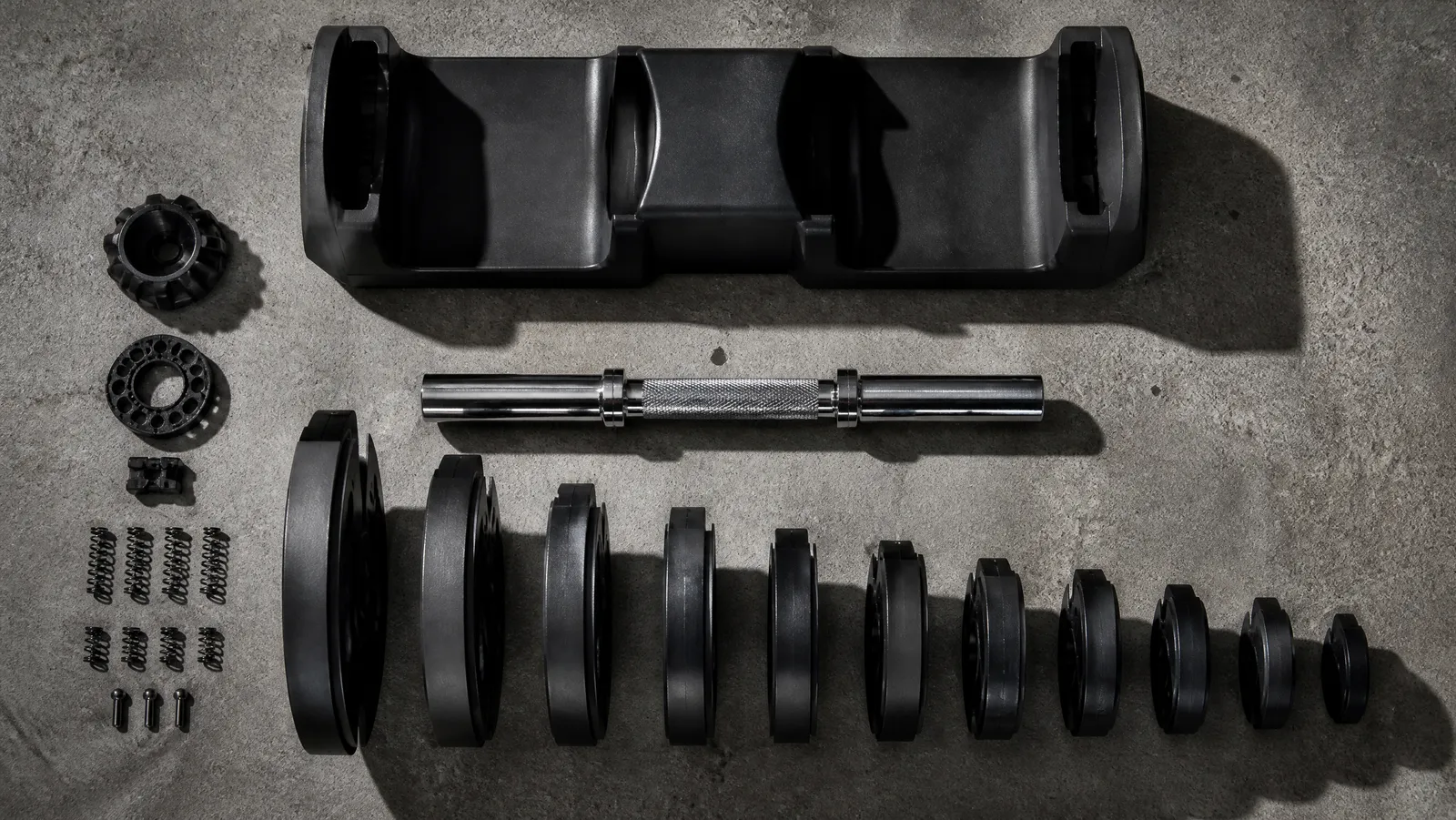
The iron is the cheap part. US scrap steel averaged about 14 cents a pound (roughly 32 cents per kilogram) in 2025, while a dial-adjust pair sells for about $5.15 per pound (around $11.35 per kilogram) of liftable load. The other $5 buys a selector mechanism, the steel mould that makes it, dense freight, and a recall reserve.
That is the short answer to why are adjustable dumbbells so expensive, and our position is that the question is usually asked backwards. Shoppers compare an adjustable bell against the price of iron, when the right comparison is against the price of a small machine that happens to be made of iron. If you are still at the buying stage, adjustable dumbbells for home gym handles the decision itself. This page is the invoice.
Below we separate the sticker into its parts, in rough order of how much each one costs the manufacturer, and we label clearly which numbers are published and which are our arithmetic on published figures.
Start from the commodity floor: what the steel actually costs
Raw ferrous metal is the smallest line on the bill. The USGS Mineral Commodity Summaries 2026 chapter on iron and steel scrap reports that "Average composite prices published for the first 11 months of 2025 for No. 1 heavy melting steel scrap ranged from a high of $366.26 per ton in March to a low of $303.46 per ton in November," and that "The annual average price delivered in 2025 was estimated to increase to $319.00 per ton compared with the full-year average of $314.85 per ton in 2024." The table carrying that series labels it "Price, average, delivered, No. 1 heavy melting composite price, dollars per metric ton."
Convert it and the floor is obvious. At $319.00 per metric ton, the metal in a 50 lb (22.7 kg) dumbbell is worth roughly $7.25 as scrap. That is our arithmetic, and it ignores casting, machining, coating and scrap-to-product yield, so treat it as a floor rather than a cost of goods.
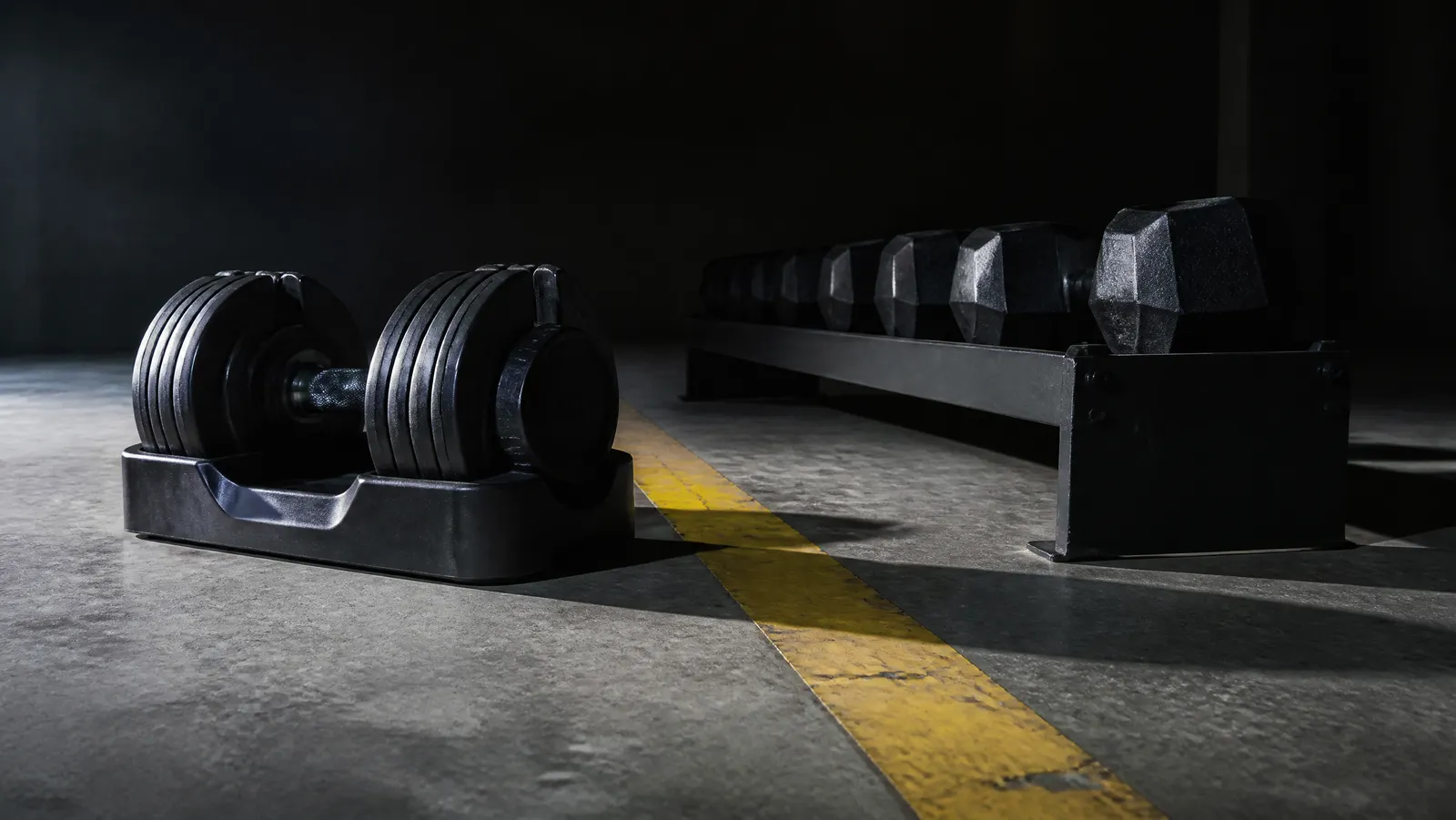
The cheapest retail weight sits surprisingly close to that floor. Dunham's lists the CAP 40lb Vinyl Dumbbell Set at $34.99, which is about 87 cents per pound (about $1.93 per kilogram) of total set weight. Plain weight is cheap. It is adjustability that is not, which is the whole argument in adjustable dumbbells vs fixed dumbbells.
Hold that 87 cents in mind. Every figure that follows is the premium over it.
The mechanism is the product, and it exists to stop a plate falling
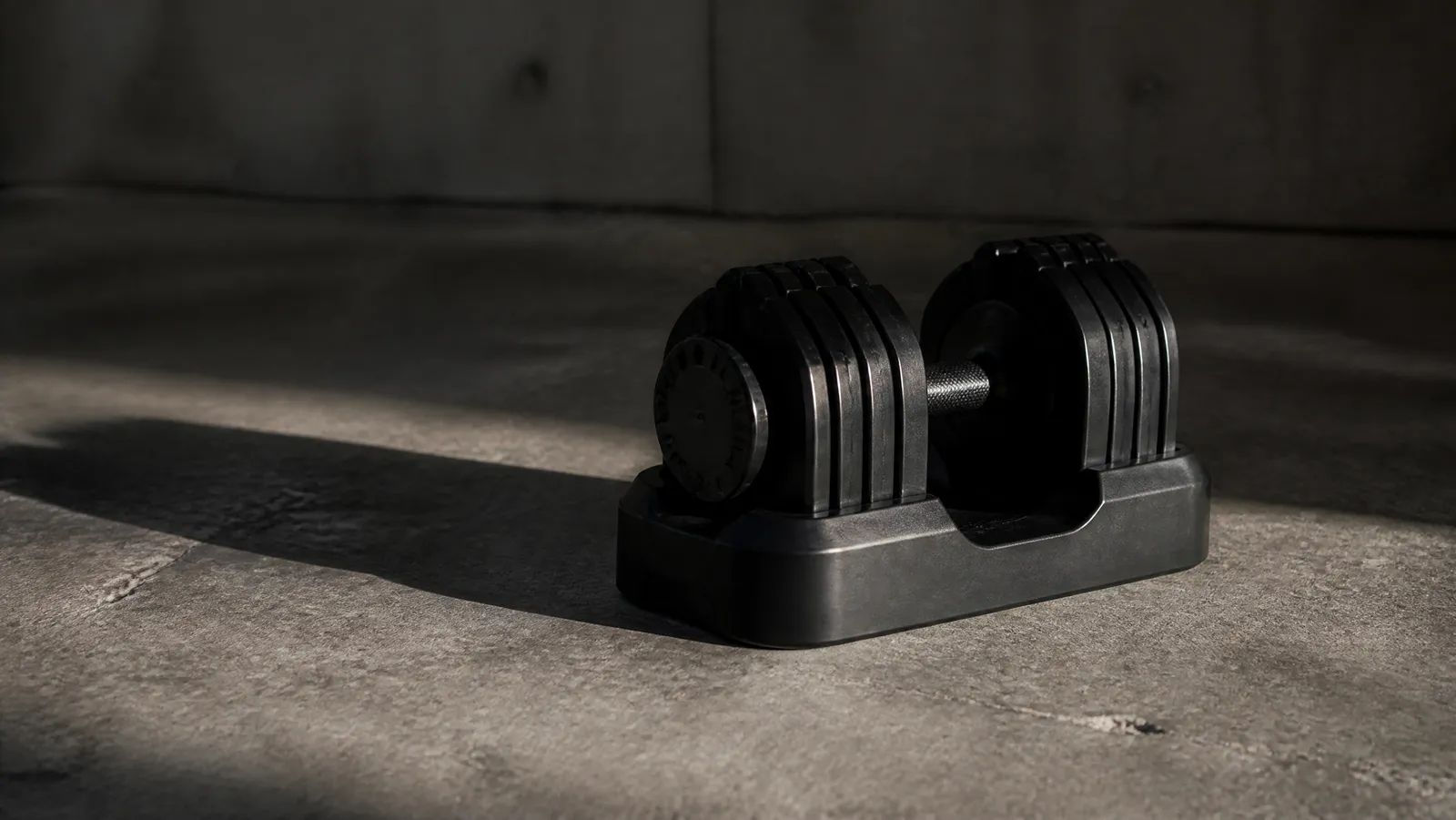
A dial bell is a precision assembly whose entire engineering budget goes on one failure mode. The Bowflex SelectTech 552 owner's manual describes a "patent pending locking mechanism designed to ensure proper and complete selection of the weight plates as well as to ensure weight plate retention during the workout," and then lists what it does in two clauses.
The first is an interlock: "The mechanism will only allow the adjustment knobs to be rotated when the dumbbell handle is completely inserted and engaging the dumbbell base." The second is a lockout: "The mechanism is designed to lock the dumbbell handle to the base if either adjustment knob is not fully engaging the selected weight plates." The manual states the purposes just as flatly. It will "prevent deselecting (dropping) weight plates from the dumbbell when it is NOT in the dumbbell base," and it will "prevent partial selection of the weight plates in which the plates are not fully supported and the locking pin is not fully engaged."
Read that as a bill of materials and you have bought a mechanism that indexes reliably across fifteen settings, thousands of times, with a plate pack hanging off it. The same manual notes the bell "is covered by US and Foreign Patents and Patents Pending."
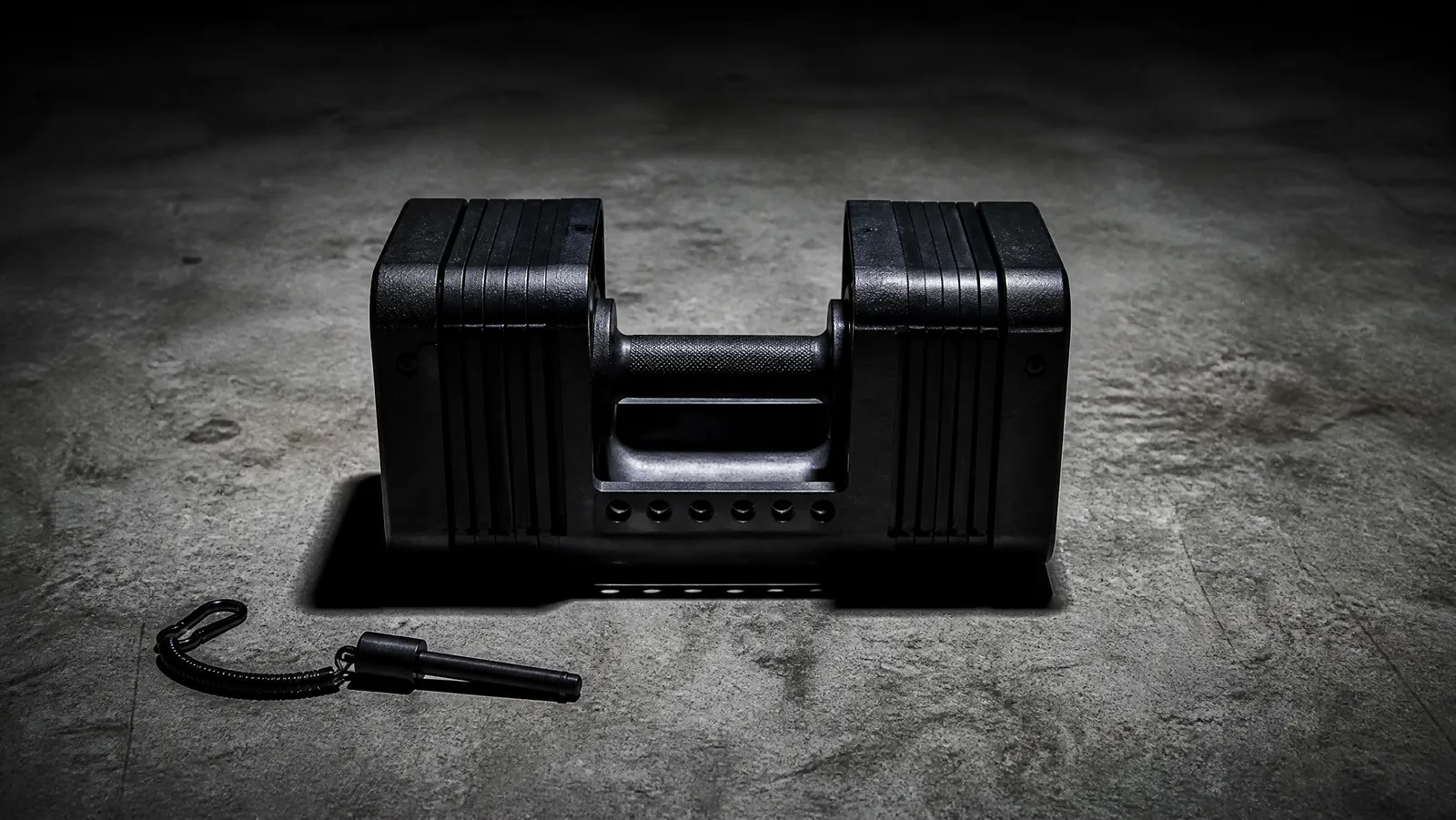
Rival designs price the same problem the same way. PowerBlock's Elite EXP specification sheet advertises a "Patented Compact Design" and a "Patented Magnetic Selector Pin" over "Solid steel plates," reducing the whole operation to "Just insert pin and lift." Body-Solid's description of the RUGGED YADB100 dial set is more explicit about what is inside: it is "Constructed with heavy-duty steel and reinforced high-impact plastic components," its "internal weight stack consists of precision-cut steel plates engineered for balanced weight distribution," and "A built-in dual-locking mechanism engages during use to secure the selected steel plates to the handle assembly and prevent accidental plate detachment during movements."
Even the simplest quick-change designs are patented engineering. Google Patents records US7182716B1, titled "Dumbbell with quick release bolt", filed in September 2003 to inventor Matthew Fredric Dawson and granted in February 2007. For how these families differ in operation, see how adjustable dumbbells work.
Our position: the selector, the moulded plate pack and the cradle are one product. You cannot buy the weight without buying the machine.
Tooling and volume: where adjustable dumbbell price per pound really starts
This is the section no spec sheet shows you, and it is mostly our analysis, so we will label it as such and anchor it on a published cost model.
A moulded plate tray and selector housing need hard tooling. The cost-estimating case study in BYU-Idaho's plastics processing text works a representative example end to end: a pocketknife "made with a nylon handle (Figure 12.29) in a two-cavity mold", for which the text books "the external costs are $5,000 and the internal costs are $15,000." That $20,000 total is written up under "the knife blade case," and the text's own amortisation then applies the same figure to the handle. Amortised across the planned run, where "In the knife handle case, the number of parts is 4,000,000," the result is tiny: "For the knife handle, the tooling cost contribution is $5.00" per thousand parts, which is half a cent per part. The same text names the constraint directly: "One of the major drawbacks to the use of injection molding is the relatively high cost of the tooling."
Now run that arithmetic at dumbbell volumes, which is our reasoning and not the text's finding. Take the same $20,000 tool. Spread it across the "About 54,400" units in CPSC recall 24-310 and tooling contributes about 37 cents per unit, roughly 74 times the knife figure. Spread it across the "About 1,845" sets in CPSC recall 25-020 and it is nearer $10.84 each.
Two honest caveats. Recall unit counts are not annual production, and a dumbbell cradle is a far larger moulding than a knife handle, so a real tool almost certainly costs more than $20,000. Both corrections push the same way: low volume makes fixed costs land hard, and a cast-iron hex dumbbell has no fixed cost to land at all.
Shipping weight is a cost you pay twice
Adjustable bells are the densest consumer parcel most people ever order. The Bowflex manual lists one dumbbell at 16.9 inches long by 8.3 wide by 9 high (43cm by 21.2cm by 22.8cm) and gives its "Dumbbell Assembly Weight" as "Approximately 58 lbs (26.3 kg)," noting the bells are "shipped fully assembled, one dumbbell to a box." That is roughly 116 lb (52.6 kg) of freight for one pair, in two cartons.
PowerBlock's sheet lists Elite EXP Stage 1 at 12 inches long by 6.3 wide by 6.5 high (30.5cm by 16cm by 16.5cm) and its shipping as two boxes. Body-Solid's listing gives the RUGGED set a "Weight: 100.00 LBS" (45.4 kg) against "Product Dimensions" of 24 by 20 by 8 inches (61 by 50.8 by 20.3 cm); it publishes no carton size, so that is product density rather than a shipping box. By our arithmetic it is about 45 lb per cubic foot, or about 721 kg per cubic metre, close to three quarters the density of water.
Dense freight is billed on real weight, not on air. We could not retrieve a current carrier surcharge table, so treat the mechanism as the claim and not a dollar figure: heavy single parcels attract handling fees that light bulky ones do not, and the manufacturer pays them twice, inbound from the factory and outbound to you. Garage Gym Reviews reaches the same place from the buyer's side: "When ordering dumbbells, the cost can quickly add up, especially when you factor in shipping fees on multiple dumbbells."
Liability, testing and recalls are inside the sticker price
Here is the line item competitors leave out, and our own reporting has already done the work. This category has had at least eight CPSC recalls since 2012, and every notice names the same hazard: weight plates leaving the dumbbell. The 2012 notice words it slightly differently, blaming a weight selector dial that "can fail, causing weight plates to fall when the dumbbell is lifted from its cradle."
The scale is the point. Recall 25-311, dated June 05, 2025, covers "About 3,844,200" BowFlex 552 and 1090 dumbbells sold "for between $200 and $800," because "The weight plates can dislodge from the handle during use, posing an impact hazard." Recall 24-310 replaced the moulded tray on about 54,400 ProForm sets. Recall 25-020 replaced grip handles on about 1,845 PowerBlock sets, where "No injuries have been reported." The oldest in the record, recall 12-194 of June 07, 2012, covering "About 17,000" SelectTech 1090 units sold "for about $600," now carries the bleakest line of all: "The firm is no longer in business and the recall remedy is no longer available." What goes wrong, and how to spot it, is the subject of are adjustable dumbbells safe.
Standards compliance is a cost too, and a voluntary one. ASTM F3105-20 is listed at "$72.00" on ASTM's store, and its abstract is modest about what it buys: the specification "aims to assist designers and manufacturers in reducing the possibility of injury" when products "are used in accordance with the operational instructions." Its scope adds that "This standard does not purport to address all of the safety concerns, if any, associated with its use."
Warranty is the most legible reserve of the three. PowerBlock's sheet promises a "5 year limited warranty." Bowflex's manual gives residential "Parts (including handle assembly, weight plates and base assembly): 2 years," and excludes "Damage to the product due to dropping the dumbbell" first on its list. Body-Solid's RUGGED set carries a "2 Year In-Home Warranty." Someone funds those years, and it is the buyer.
One health caveat, because it belongs here rather than in a footnote. Nothing on this page is medical advice, and if you are loading a joint that has been injured, get assessed by a clinician or a qualified coach before you add weight to it.
Where a cheap adjustable dumbbell saves the money
Every cheap-bell compromise is legible in the listing if you read it as a cost sheet. Here is the checklist we use.
- Fill material instead of steel plates. The CAP set's own listing says "Plates made of heavy-duty vinyl filled with cement." Cement is less dense than cast iron, so the same load takes more room, and in our reading the fill is the cheaper half of the bill.
- A spun collar instead of a mechanism. That set lists "four spring clip collars for securing cement-filled plates" and "two tubular steel bars." There is no selector, no interlock, no detent, and therefore no tooling to amortise.
- No cradle. A dial bell's base is part of the mechanism, which is why CPSC recall 24-310's remedy was a replacement moulded tray rather than a handle. A cheap set has no base to replace.
- A headline weight that describes the whole set. The listing's own plate list, four 7.5 lb (3.4 kg) and four 2.5 lb (1.1 kg) plates, already sums to the full 40 lb (18.1 kg) headline before the two bars are counted, which leaves about 20 lb (9.1 kg) of plates per hand. Compare that to Body-Solid's pro-style plate-loaded pair at $285.00, which reaches "up to 50 lbs. per dumbbell" using "sixteen five lb. plates, four 2.5 lb. plates, and two knurled dumbbell handles with spin lock collars."
- Plastic in the load path. Garage Gym Reviews scores for exactly this, noting "we don't like to see too many plastic moving parts on adjustable dumbbells," and reserving a middling grade for sets that "shouldn't be dropped regularly."
- A short warranty, or none published. The CAP listing we retrieved states no warranty term. Against a "5 year limited warranty," that absence is a price.
- No recall history, because the brand is new. A clean record on a three-year-old marketplace brand is not evidence of a safer mechanism. That is our judgement, not a finding.
None of this makes a cement set a bad purchase. It makes it a different purchase, priced honestly for what it is.
Adjustable dumbbells cost per pound, in one table
Price divided by maximum liftable load for the pair, which is our arithmetic on their published figures.
| What you buy | Price | Max load, pair | Dollars per pound of load | |---|---|---|---| | No. 1 heavy melting scrap, 2025 average | $319.00 per metric ton | n/a | about $0.14 (about $0.32/kg) | | CAP 40lb vinyl and cement set | $34.99 | 40 lb (18.1 kg) total | about $0.87 (about $1.93/kg) | | Body-Solid pro-style plate-loaded pair | $285.00 | 100 lb (45.4 kg) | about $2.85 (about $6.28/kg) | | RUGGED by Body-Solid YADB100 dial pair | $515.00 | 100 lb (45.4 kg) | about $5.15 (about $11.35/kg) |
Four steps, one pattern. Each rung adds a mechanism, and the metal barely moves.
The honest answer on adjustable dumbbells cost
Per pound, adjustable dumbbells get more expensive the more you spend, and that is not a markup scandal. Past roughly the first $100 you have stopped buying weight and started buying the machine around it: a selector rated to index under load, the tooling that makes it, the freight to move a dense box, and the warranty and recall reserve behind a product that drops plates when it fails.
Whether that machine is worth the premium over a rack of fixed iron is a separate question, and we answer it in are adjustable dumbbells worth it. For the full buying picture, including which mechanism suits which room, see our complete adjustable dumbbell guide.
Weight is a commodity. Convenience is a product. You are buying the second one.
What to know before you buy
Field Notes
How much of an adjustable dumbbell's price is actually the metal?
A small fraction, on the published numbers. The USGS [Mineral Commodity Summaries 2026 entry for iron and steel scrap](https://pubs.usgs.gov/periodicals/mcs2026/mcs2026-iron-steel-scrap.pdf) reports that "The annual average price delivered in 2025 was estimated to increase to $319.00 per ton compared with the full-year average of $314.85 per ton in 2024," on a series its table labels "Price, average, delivered, No. 1 heavy melting composite price, dollars per metric ton." That is about 14 cents a pound (about 32 cents per kilogram). A dial pair such as the [RUGGED by Body-Solid YADB100, listed at $515.00](https://bodysolid.com/rugged-by-body-solid-5-50-lb-adjustable-dumbbell-set/), works out near $5.15 per pound (about $11.35 per kilogram) of liftable load. That gap is our arithmetic on their figures, and the mechanism, tooling, freight and warranty live inside it.
Are cheap adjustable dumbbells with cement plates a reasonable buy?
They are a different product wearing the same words, and the listings say so themselves. Dunham's listing for the [CAP 40lb Vinyl Dumbbell Set, priced at $34.99](https://www.dunhamssports.com/cap-40lb-vinyl-dumbbell-set-W0000183927.html), lists "Plates made of heavy-duty vinyl filled with cement," and says the set comes with "two tubular steel bars, four 7.5lb plates, four 2.5lb plates and four spring clip collars for securing cement-filled plates." Read the headline weight carefully: 40 lb (18.1 kg) is the whole set, so one hand tops out near 20 lb (9.1 kg) of plates. For a beginner pressing light that may be enough. Independent testers are wary of the materials further up the category too: [Garage Gym Reviews' dumbbell testing methodology](https://www.garagegymreviews.com/ggr-dumbbell-testing-methodology) says "we don't like to see too many plastic moving parts on adjustable dumbbells."
Why does shipping an adjustable dumbbell cost so much?
Because the box is small, dense and heavy, which is the worst combination in parcel freight. The [Bowflex SelectTech 552 owner's manual](https://cdn.shopify.com/s/files/1/0604/6708/5501/files/BFX_SelectTech552.pdf) gives the assembly weight as "Approximately 58 lbs (26.3 kg)" per dumbbell and notes the bells are "shipped fully assembled, one dumbbell to a box," which is roughly 116 lb (52.6 kg) of freight for one pair. Body-Solid's listing for the [RUGGED YADB100](https://bodysolid.com/rugged-by-body-solid-5-50-lb-adjustable-dumbbell-set/) lists a "Weight: 100.00 LBS" (45.4 kg) against "Product Dimensions" of 24 by 20 by 8 inches (61 by 50.8 by 20.3 cm), which is about 45 lb per cubic foot (about 721 kg per cubic metre) by our arithmetic. Body-Solid publishes no carton size, so read that as product density, not a box. [Garage Gym Reviews](https://www.garagegymreviews.com/ggr-dumbbell-testing-methodology) puts the consequence plainly: "When ordering dumbbells, the cost can quickly add up, especially when you factor in shipping fees on multiple dumbbells."
What does a recall cost an adjustable dumbbell brand?
Enough to be priced in before it happens, judging by the notices. CPSC [recall 24-310, dated July 25, 2024, covering "About 54,400" ProForm Rapid Strike 50 LB sets](https://www.cpsc.gov/Recalls/2024/iFIT-Recalls-ProForm-50-LB-Adjustable-Dumbbells-Due-to-Impact-Injury-Hazard) sold for "about $350," had owners "contact iFIT to receive a free repair in the form of a replacement for the molded tray." CPSC [recall 25-020, dated October 24, 2024, covering "About 1,845" PowerBlock Commercial Pro 100 sets](https://www.cpsc.gov/Recalls/2025/PowerBlock-Recalls-Commercial-Pro-100-Weight-Sets-Sold-with-5-lb-Grip-Handles-Due-to-Impact-Injury-Hazard) sold "for about $1,500 for the Commercial Pro 100 set" promised "free replacement 5 lb grip handles." And [recall 25-311 reached "About 3,844,200" BowFlex 552 and 1090 units](https://www.cpsc.gov/Recalls/2025/Johnson-Health-Tech-Trading-Recalls-BowFlex-Adjustable-Dumbbells-Due-to-Impact-Hazard-Including-3-7-Million-Sold-by-Nautilus-Inc) sold "for between $200 and $800." No notice publishes a remedy cost, so the size of the reserve is our inference, not their disclosure.
Is there a safety standard adjustable dumbbells must be tested against?
Not a mandatory one we could find, and the closest document is sold rather than published. [ASTM F3105-20, Standard Specification for Externally Loaded Strength Training Equipment, Strength Training Benches and External Weight Storage Equipment](https://store.astm.org/f3105-20.html), is listed at "$72.00" on ASTM's own store, and its abstract says the specification "aims to assist designers and manufacturers in reducing the possibility of injury" only "when the products are used in accordance with the operational instructions." Its scope adds that "This standard does not purport to address all of the safety concerns, if any, associated with its use." The European general document, [EN ISO 20957-1:2024](https://online.standard.no/en/ns-en-iso-20957-1-2024), covers "indoor stationary training equipment," which its clause 3.1 defines as "equipment that is not moved as a unit during use." A dumbbell is moved as a unit, so it sits outside that definition. In our reading, conformance testing here is a cost a maker chooses, not a gate a product must pass.
Who put in the work
The Coach
Your Coach
Darlene Schmitt
I am a fitness instructor and promoter who truly enjoys helping others become the best they can be! My mission is to help people find the love of fitness and to help them develop a lifelong habit of exercise. I am a firm believer that fitness should be fun, and I make it my mission to ensure that my classes are always enjoyable. I am also a certified nutritionist and personal trainer, so I am able to offer my students comprehensive and well-rounded support.