Adjustable dumbbells for a home gym: the complete guide

Contains affiliate links. Our policy.
For most people building a home gym in a limited space, one pair of adjustable dumbbells does replace a rack of fixed bells, and the decision worth agonising over is which mechanism and what top-end weight — not whether to buy adjustable at all. The caveat that matters: the category's weak point is not performance, it is that weight plates come off handles, and that has triggered at least eight separate recalls in the United States since 2012.
That is the shape of the whole page. Choosing adjustable dumbbells for a home gym means pricing two real advantages — floor space and load increments — against one risk that fixed iron does not have.
One caution before any of it, because it belongs early. Every recall in this category describes the same hazard: the US Consumer Product Safety Commission's June 2025 notice states that "The weight plates can dislodge from the handle during use, posing an impact hazard." If you are pressing a selectorised bell over your face, that sentence is the specification that matters most. And if you are managing a shoulder, back or joint problem, get assessed by a clinician or a qualified coach before you start loading any of the patterns described further down.
How the three mechanisms actually work
There are only three answers to how adjustable dumbbells work, and each one trades away something different.
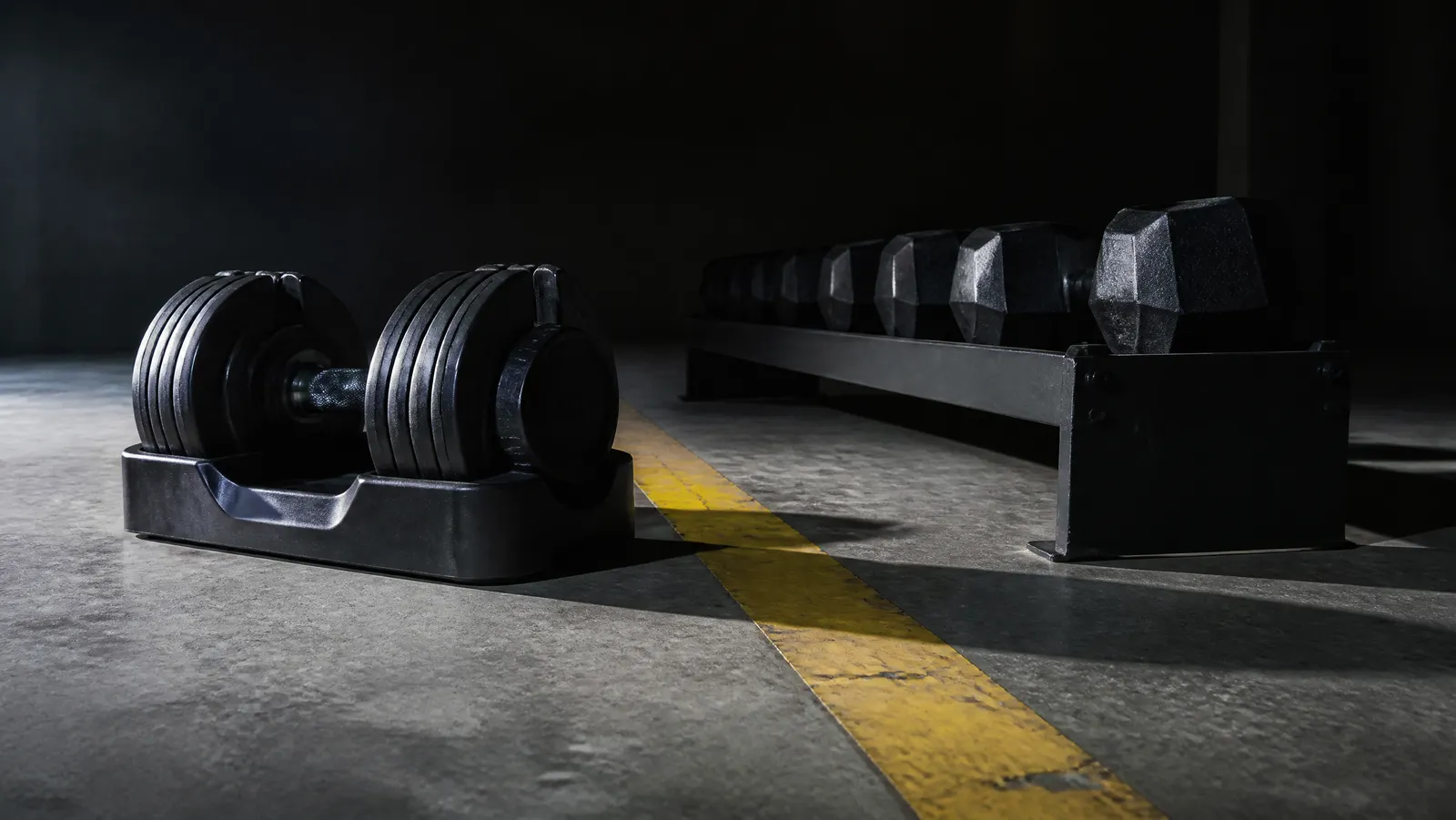
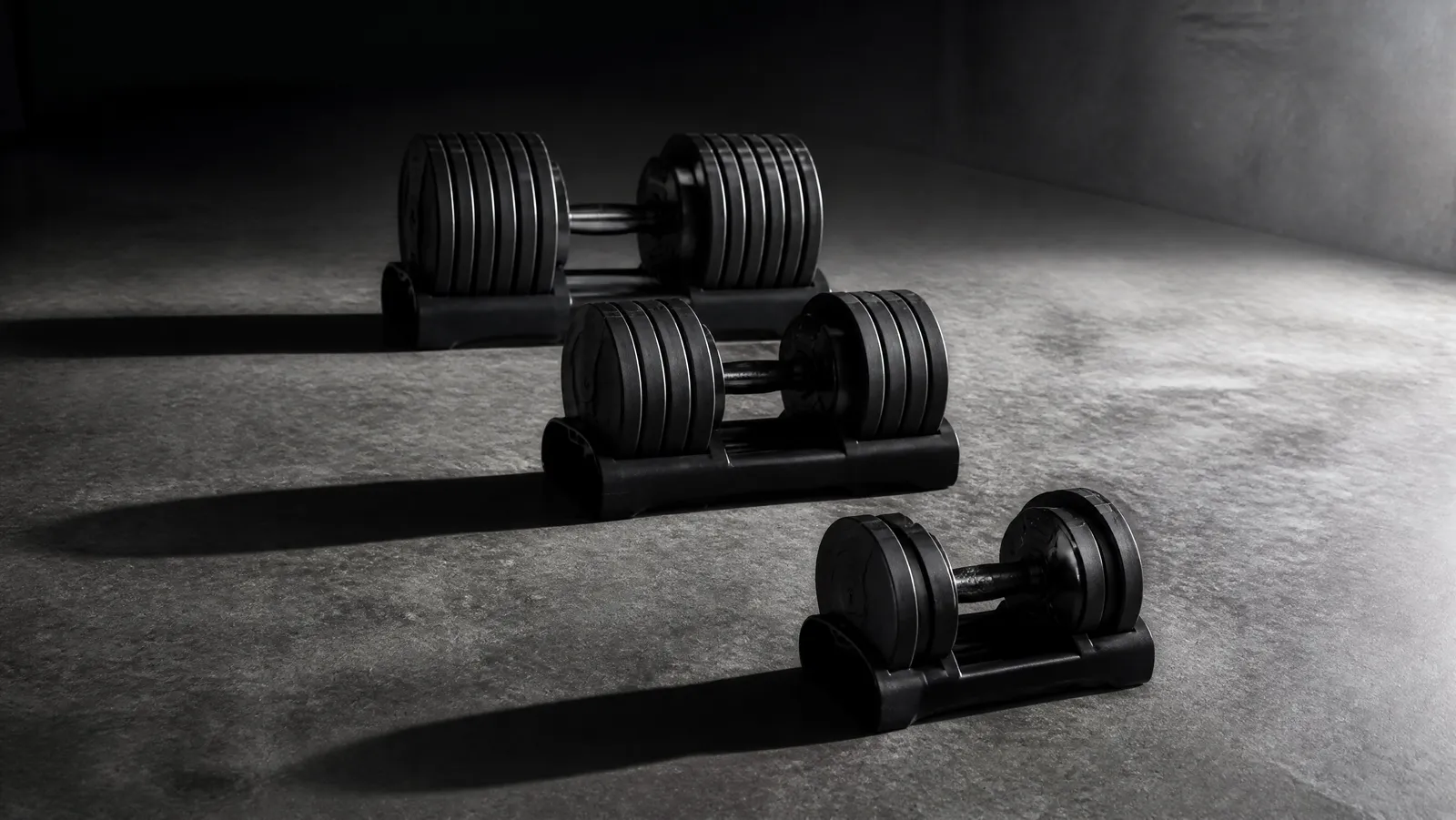
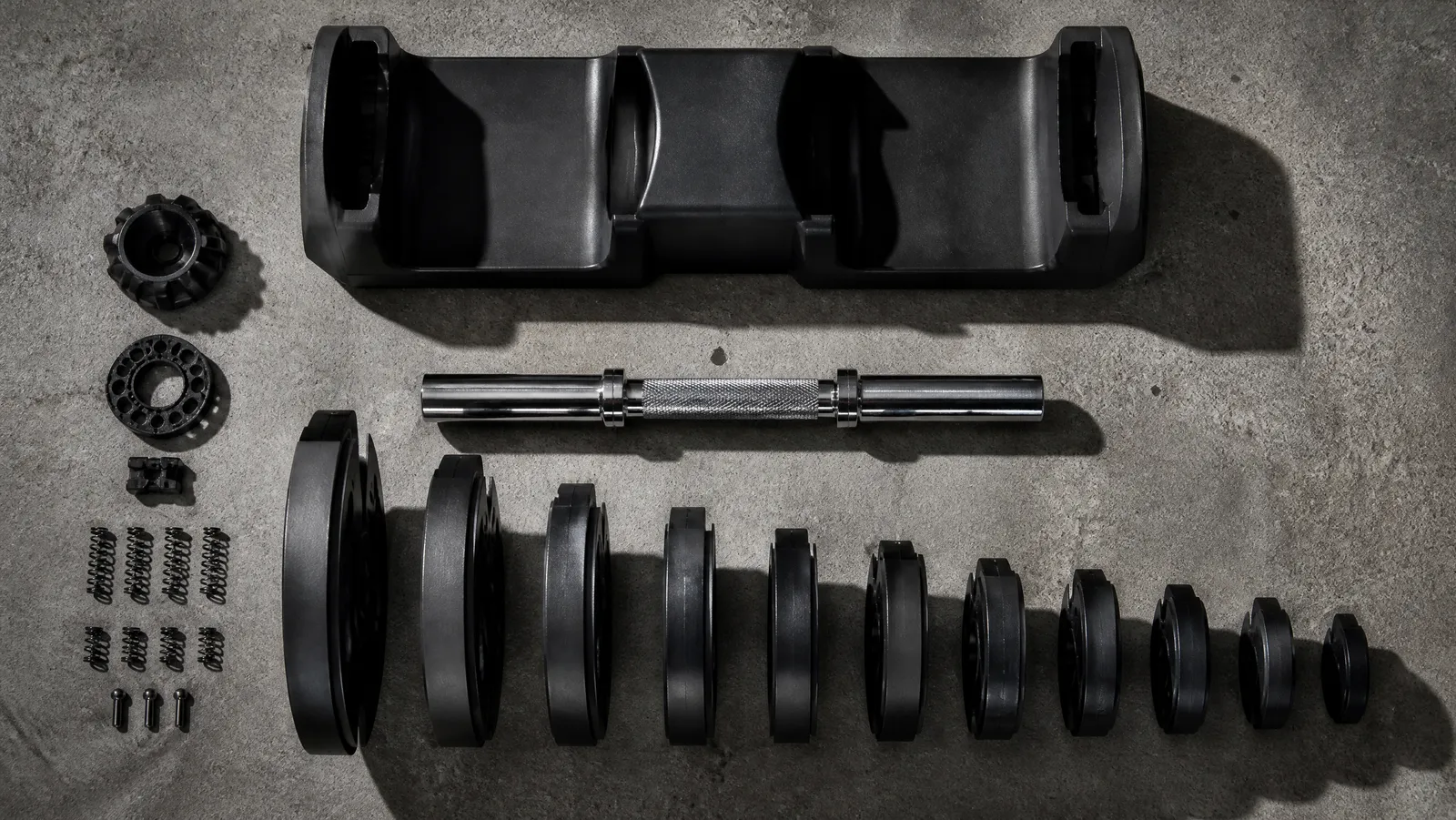
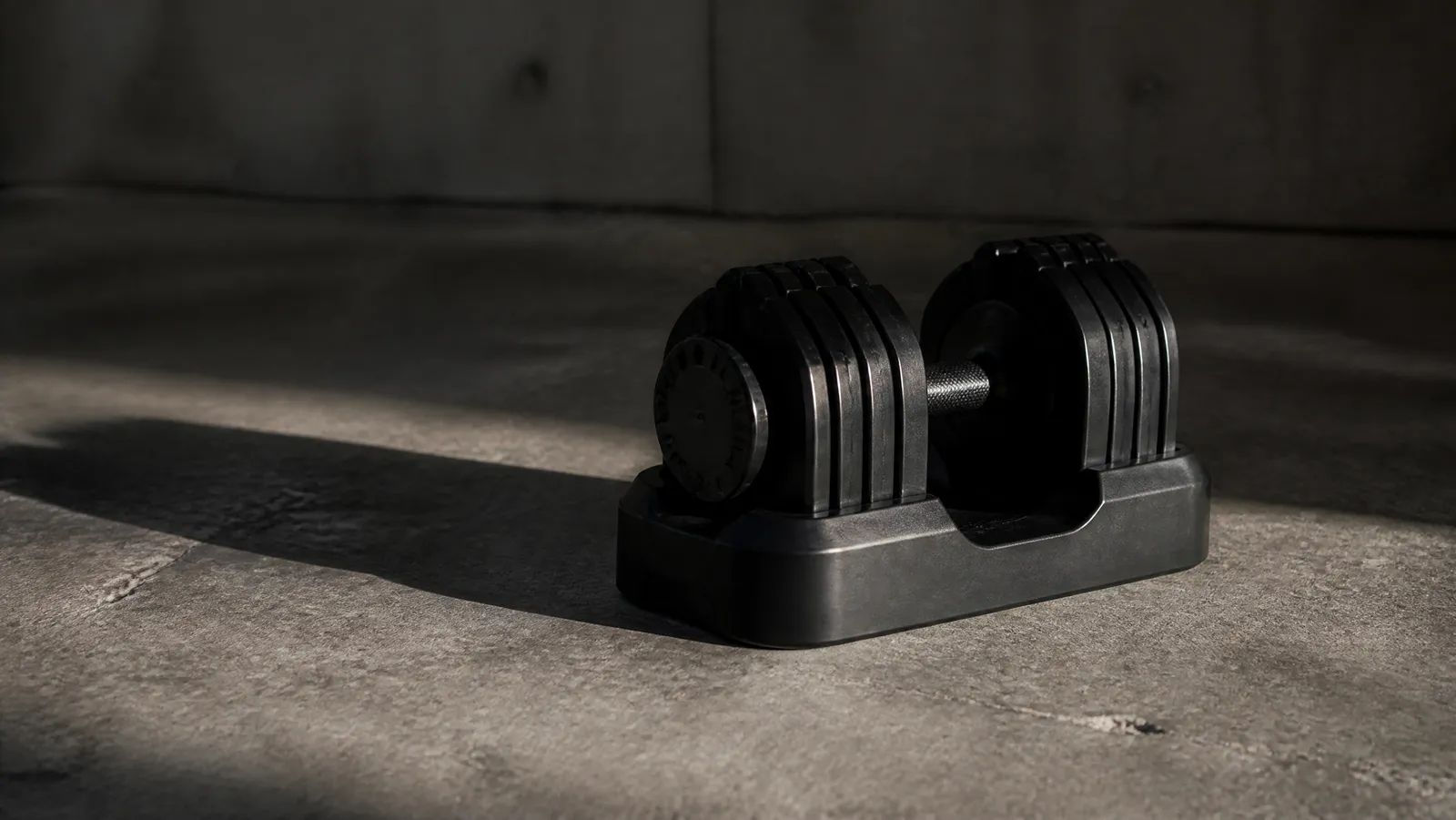
Dial-adjust bells leave the plates in a cradle and let the handle pick up what you select. Turning a dial at each end of the handle engages a number of nested plates; the rest stay in the tray. Garage Gym Reviews, whose adjustable-dumbbell guide was last updated on 16 October 2026 and which scores each bell on "durability, weight options, adjustment speed, handle design, value, and more", lists the Bowflex SelectTech 552 at 5-52.5lb (2.3-23.8kg) in 2.5lb (1.1kg) and 5lb (2.3kg) increments, and the 1090 at 10-90lb (4.5-40.8kg) in 5lb (2.3kg) increments. Its reviewer calls weight changes on the 1090 "literally as easy as turning a dial" and credits the NUOBELL — 5-80lb (2.3-36.3kg) in 5lb (2.3kg) steps — with "one of the fastest weight changes we've seen". What you trade is dependence on the cradle: the bell cannot be adjusted anywhere else, and the selector is load-bearing.
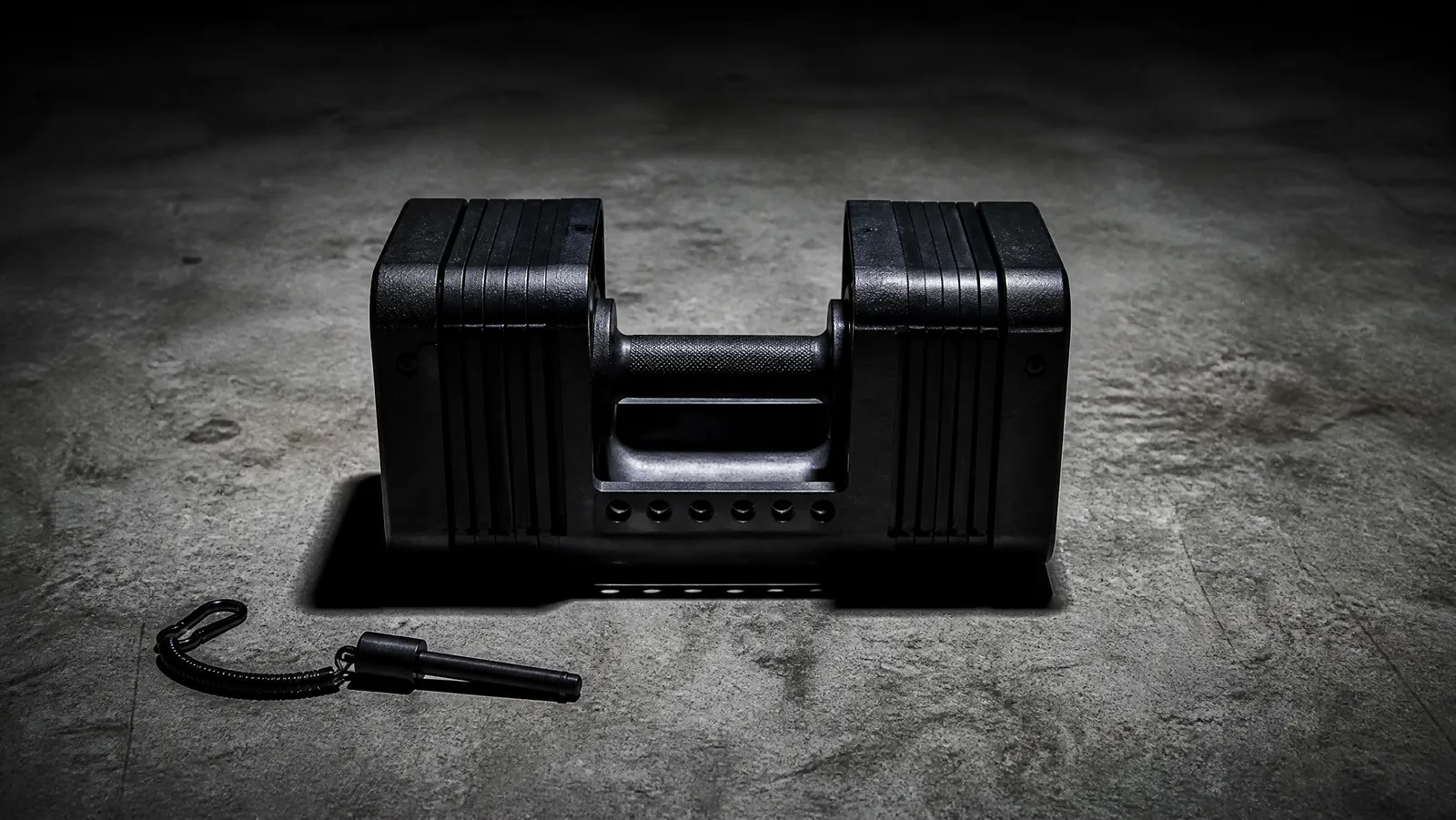
Pin-selector bells nest shells inside each other and use a pin to decide how many you lift. PowerBlock is the category here, and the adjustment is a pin pushed through a stack rather than a dial turned in a cradle. Garage Gym Reviews puts the Pro 100 EXP at 5-40lb (2.3-18.1kg) per hand with add-on kits to 60, 80 or 100lb (27.2, 36.3 or 45.4kg) in 2.5lb (1.1kg) or 5lb (2.3kg) increments, replacing "up to 30 pairs" — "an entire dumbbell rack" — and calls the brand's bells "historically some of the most durable adjustable dumbbells on the market." What you trade is ergonomics and time: your hand sits inside a square cage rather than around a cylinder, and the same guide logs "Not the fastest change in weights" as a standing con.
Plate-loaded bells are a short barbell with a lock. Spin-on collars are the old version of the idea; Ironmaster's Quick-Lock is the engineered one. Garage Gym Reviews puts the Quick-Lock at 12.5-47.5lb (5.7-21.5kg), or 22.5-57.5lb (10.2-26.1kg) with an add-on kit to 70 or 80lb (31.8 or 36.3kg), in 2.5lb (1.1kg) increments, replacing 24 pairs. Fewest moving parts, longest adjustment time: you are handling loose plates rather than turning a dial.
Three mechanisms, three currencies: the dial spends reliability, the pin spends comfort, the plate spends time.
Are they safe, and what actually fails
The useful version of are adjustable dumbbells safe is a question about the recall record, which in this category is unusually specific about the failure mode.
At least eight US recalls since 2012, one sentence between them. The CPSC's 2012 notice covered about 17,000 Bowflex SelectTech 1090 dumbbells, because "The weight selector dial on the units can fail, causing weight plates to fall"; Nautilus had received "16 reports of the weight selector dial failing," including "three reports of injuries to the user's foot or leg." iFIT's July 2024 recall covered "About 54,400 (In addition, about 650 sold in Canada)" ProForm Rapid Strike 50 LB sets, on "eight reports of weight plates dislodging during use with three resulting in injuries". The June 2025 BowFlex recall, number 25-311, covered "About 3,844,200" units sold "for between $200 and $800": Nautilus had "received 337 reports of the plates dislodging during use for units it sold," with "111 resulting in injuries such as concussions, abrasions, broken toes or contusions," while Johnson Health Tech Trading "has received 12 reports of the plates dislodging during use with no injuries". And the April 2026 FitRx SmartBell Quick-Select recall, number 26-431, covered about 50,000 units sold at Walmart for about $100, citing "more than 115 reports of weight plates dislodging during use" with "at least six injuries". Four further CPSC notices describe the same failure mode on other bells: NordicTrack's 50 LB iSelect in February 2024, about 15,400 units on 40 reports and eight injuries; PowerBlock's Commercial Pro 100 5lb (2.3kg) grip handles in October 2024; the FitRx SmartBell XL in March 2025, about 12,400 units on more than 60 reports and at least seven injuries; and Amazon Basics' 55lb (24.9kg) bells in May 2026, about 2,900 units on eight reports and no injuries.
Read the limits of that record before drawing the obvious conclusion. Recall counts are reports, not rates: 111 injuries across 3.8 million units sold since 2004 has no denominator for hours trained, and no comparison group — nobody counts the toes broken by fixed dumbbells rolling off a rack. This part is our editorial judgement, not a published finding: we have found no peer-reviewed study comparing injury rates between adjustable and fixed dumbbells.
What the record does support is a short list of handling rules, all of them derived from the same failure mode.
- Seat the handle fully in its tray before and after every change. Every dial-adjust failure in the notices above involves the selector and the plates it is supposed to hold.
- Lift the bell straight up out of the cradle, then look at it. The 2012 hazard sentence describes plates falling as the dumbbell is lifted from its cradle, which makes that first second the moment to notice a bad selection.
- Do not press a freshly adjusted bell over your face. That is our judgement, not a published rule, and it costs you nothing.
- Check serials, not model names. The 2025 notice spans multiple serial ranges across two models.
- Stop, and do not resell. The 2012 notice ended with "No Remedy Available" and "Discard this product. Do not donate or resell."
Eight recalls in fourteen years is not a reason to avoid the category. It is a reason to buy the mechanism, not the number on the box.
Adjustable or a fixed set?
The adjustable dumbbells vs fixed dumbbells argument is usually run on feel. Asking whether adjustable dumbbells are good in the abstract produces an argument; asking which of three numbers you are short of produces a decision. Those numbers are dollars per pound, square feet, and seconds between sets.
Dollars per pound favours iron, and it is not close. Garage Gym Reviews' fixed-dumbbell guide prices REP's rubber-coated hex dumbbells at "As low as $1.76" per pound and Rogue's urethane dumbbells at a starting $4 per pound, noting "Expensive cost starting at $54 for a pair of 5-pound weights". Adjustable bells land in the urethane bracket and above: the same site's adjustable guide puts the average adjustable dumbbell at $625, the SelectTech 552 at "less than $480", the NUOBELL at $780, the Bowflex 1090 at $799 and a 100lb (45.4kg) PowerBlock setup at "nearly $1,200" — all as of that guide's October 2026 update. Our arithmetic on those published prices: a 552 pair holds 105lb (47.6kg) of total usable weight for under $480, about $4.57 per pound, and the 100lb PowerBlock setup runs about $6 per pound. That is two and a half to three and a half times the rubber-hex floor.
Then flip the arithmetic, because you are not buying the same pounds. To cover 5-50lb (2.3-22.7kg) per hand in 5lb (2.3kg) steps with fixed bells you need ten pairs, which is 550lb (249kg) of iron. At $1.76 per pound that is roughly $968 — our calculation from the prices above, not a figure either site publishes. The adjustable pair covers the same range with 105lb (47.6kg) of metal. Adjustable dumbbells are expensive per pound and cheap per range, and almost every argument about them is someone quoting one of those two facts at someone quoting the other.
Square feet is where adjustable weights for a home gym win outright. Garage Gym Reviews' own replacement figures run from 16 pairs for the NUOBELL to 17 for the Bowflex 1090, 19 for the MX100, 24 for the Ironmaster Quick-Lock and "up to 30 pairs" for the PowerBlock Pro 100 EXP — "an entire dumbbell rack". Its fixed-dumbbell guide puts the counterfactual plainly: "You'll need a good bit of space to house a full weight set, which may not be the case for apartment dwellers."
Seconds between sets is the hidden cost. A fixed rack changes weight in the time it takes to let go. Dial bells are a second or two, pin bells slower, plate-loaded bells slowest — and if your programme uses drop sets or supersets, that gap compounds across a session.
Our position: if you have the floor space and buy second-hand iron, fixed wins on money. If you do not, the question answers itself.
How much top-end weight you need
Pick the top end by the lift that needs it most, and that lift is almost never the one people shop for. Deciding what weight adjustable dumbbells to buy by imagining your bench press is how people end up with a bell their rows outgrew in a month.
Start from what the guidelines ask of the load. ACSM's 2009 position stand recommends for novice strength training "Training with loads 60-70% of 1 RM for 8-12 repetitions," and for hypertrophy in novice and intermediate trainees that "moderate loading be used (70-85% of 1 RM) for 8-12 repetitions per set for 1-3 sets per exercise." ACSM's summary of its 2026 position stand puts the maximum-strength target higher still, at "80% of one-repetition maximum (1RM)" for "2-3 sets per exercise". A top-end setting that is not at least your 8-rep load on your heaviest dumbbell pattern cannot deliver any of those prescriptions for that pattern.
The patterns that need the most load, in our experience of programming around one pair, are the single-leg and hinge patterns and the one-arm row — not the press. A split squat and a Romanian deadlift are loaded by your legs; a dumbbell press is loaded by one shoulder and one triceps. That ranking is mechanics and our editorial judgement, not a published finding: we have found no trial ordering dumbbell exercises by how quickly each outgrows a fixed load.
So the arithmetic, applied honestly:
| Top end per hand | What it comfortably covers | Where it runs out | |---|---|---| | 25lb (11.3kg) | Lateral raises, curls, rear delts, light high-rep accessory volume | Every multi-joint pattern, quickly | | 50-52.5lb (22.7-23.8kg) | Pressing and rowing for most adults for years | Split squats, RDLs, heavy carries | | 70-90lb (31.8-40.8kg) | Lower-body patterns, long-term | Barbell-territory loads only |
The 50-52.5lb (22.7-23.8kg) bracket is where most of the market sits and most of the value is, because it covers upper-body work for the long run. If your training is conditioning-led instead — the case behind most hyrox home gym equipment buys — the top end matters far less than the speed of the change.
It is not that 52.5lb (23.8kg) is a light dumbbell. It is that your legs were never the thing holding it.
Are adjustable dumbbells worth the money?
The question are adjustable dumbbells worth it comes down to one thing the money buys that iron cannot, and two situations where it buys nothing.
The thing it buys is step size. ACSM's 2009 position stand recommends, as evidence category B, that "When training at a specific RM load, it is recommended that a 2-10% increase in load be applied when the individual can perform the current workload for 1-2 repetitions over the desired number on two consecutive training sessions." Fixed dumbbell sets are, in the shops we watch, usually sold in 5lb (2.3kg) steps, and that observation is ours rather than a published figure. A 5lb (2.3kg) step on a 20lb (9.1kg) bell is a 25 percent increase — two and a half times the top of ACSM's range. A 2.5lb (1.1kg) adjustable increment on the same bell is 12.5 percent, and on a 50lb (22.7kg) setting it is 5 percent, squarely inside the recommendation. That is a genuine programming advantage, and it is the one most buyers never think about.
The second thing it buys is permission to stop shopping. ACSM's 2026 summary states that "Traditional gym settings are not needed to see results," and one pair with a usable range covers the prescription above.
Where it does not pay:
- If you need to drop the weight, or train explosively. Warranty language is the tell. Garage Gym Reviews records a two-year warranty covering drops from 32 inches (81cm) on the Snode AD80 and 30 inches (76cm) on the MX100 Evolution, while writing of the NUOBELL that it is "not a set of adjustable dumbbells I would suggest dropping from even a couple of inches off the ground." Fixed rubber hex has no such clause.
- If the budget is genuinely tight. Iron runs under $2 per pound, and a meta-analysis of eight studies comparing elastic tubes and bands against machines and dumbbells for muscular strength found no significant difference for lower-limb strength (standardized mean difference = 0.09; 95% confidence interval = -0.18, 0.35; p = 0.52), concluding that "Elastic resistance training is able to promote similar strength gains to conventional resistance training." Read the limit: eight studies, strength only, no hypertrophy outcome — so resistance bands for a full body workout is a defensible starting budget, not an equivalent.
Why the price looks the way it does
The short answer to why adjustable dumbbells are so expensive is that you are buying a machine, not a casting — and the price of the metal inside it is published.
The steel is the cheap part. Rubber-coated hex dumbbells retail from about $1.76 per pound, which is roughly what loose iron costs with a coating and a warehouse attached. A 552-style pair tops out at 105lb (47.6kg) of total weight, so on that per-pound figure the metal accounts for well under half of a sub-$480 price.
The mechanism is the expensive part, and the plastic in it is the risk. A fixed dumbbell is one shape. A dial-adjust bell needs a stack of nested plates that each have to index individually, a selector at each end of the handle, and a tray that holds the lot in register. Garage Gym Reviews' durability scoring is built on exactly this distinction — "Scores of 4 out of 5 or higher are awarded to dumbbells that use minimal plastic components" for adjustables, and its fixed-dumbbell guide says "A 4-out-of-5 score or better is reserved for dumbbells made mostly of metal that can withstand consistent use." It is the same mechanism premium we described in our guide to the best adjustable kettlebells: one shell, many settings, and a lock you now depend on.
Where a cheap bell saves the money is the tray and the lock. The recalled FitRx SmartBell Quick-Select sold for about $100 and drew more than 115 reports of weight plates dislodging during use, with the remedy being a free replacement of the dumbbell and tray. The remedy for the recalled ProForm sets was, specifically, a free replacement molded tray. Two recalls, two remedies, both aimed at the part that holds the plates.
That is not proof that cheap bells fail and expensive ones do not; the 2025 recall covered bells sold for up to $800. It is evidence that the part worth paying for is the one nobody photographs.
What you can actually train with one pair
The shape of a dumbbell-only workout plan built on a single adjustable pair is a three-day full-body rotation, and the guidelines support that shape directly. ACSM's 2009 position stand recommends, as evidence category A, that "novice individuals train the entire body" two to three days per week with "1-3 sets per exercise", that loads "correspond to a repetition range of an 8-12 repetition maximum (RM)", and that "Unilateral and bilateral single- and multiple-joint exercises should be included with emphasis on multiple-joint exercises for maximizing strength in novice, intermediate, and advanced individuals." For rest it recommends "rest periods of at least 2-3 min" for core exercises with heavier loads and "1-2 min" for assistance work.
That prescription, expressed as one pair of dumbbells three days a week:
| Day | Movements | Sets and reps | |---|---|---| | A | Goblet or dual-bell front squat, one-arm row, floor or bench press, suitcase carry | 3 x 8-12 on the first three, 3 carries of 30-40m | | B | Romanian deadlift, half-kneeling one-arm press, split squat, dumbbell curl | 3 x 8-12, split squats per side | | C | Rear-foot-elevated split squat, bench or chest-supported row, incline press, lateral raise | 3 x 8-12, raises at 2 x 12-15 |
Two notes about that table. Three sets across three sessions is how you reach the volume target in the next section, which is why there are three days rather than two. And the rotation is deliberately rowing-heavy, because one pair of dumbbells starves horizontal pulling faster than anything else in a home gym.
What one pair cannot do is ballistic work. A dumbbell has no displaced centre of mass and no handle you can let rotate, which is the whole argument in kettlebell vs dumbbell, and swings with a dumbbell are a compromise rather than a substitute. A bench is the other gap: it is not required by anything ACSM recommends, but it changes the press and the row more than any other single purchase, and 5 best home gym benches covers what to look for.
Can one pair build muscle?
Yes, and the evidence for it is stronger than the evidence for almost anything else on this page. The question can you build muscle with dumbbells only turns out to be mostly about volume and effort rather than about the implement.
The load question is settled about as well as training science settles anything. Schoenfeld and colleagues, in the Journal of Strength and Conditioning Research, pooled 21 studies comparing low loads (60 percent of one-rep max or less) against heavier loads with every set taken to momentary muscular failure, and reported that "Changes in measures of muscle hypertrophy were similar between conditions," while "Gains in 1RM strength were significantly greater in favor of high- vs. low-load training." Their conclusion: "maximal strength benefits are obtained from the use of heavy loads while muscle hypertrophy can be equally achieved across a spectrum of loading ranges." Read the limit, because it is the limit that matters here: that meta-analysis compared loading ranges, not implements, and every set in it went to failure.
Volume is the other half. ACSM's summary of its 2026 position stand — synthesised, per ACSM's own announcement, from 137 systematic reviews representing more than 30,000 participants — sets the hypertrophy target as "higher weekly volume (~10 sets per muscle group)". Ten sets per muscle group per week is entirely reachable with one pair and the three-day rotation above.
On the implement itself the guidance is indifferent: ACSM's 2009 stand states that "Both free weights and machines are effective for increasing strength." We looked for a long-term trial comparing a dumbbell-only programme against a barbell programme for hypertrophy and did not find one; the literature on this question is acute EMG work, not training studies. Anyone telling you dumbbells build more or less muscle than a barbell is reasoning, not citing.
Where a fixed top end stops progress is precise, and it follows from the step-size rule above. Once your top setting is your 8-rep maximum on a pattern, the 2-10 percent load increase ACSM recommends is no longer available there — you can add sets, reps, tempo or unilateral work, but not load. That happens to the squat and the hinge first and the press last, the mirror image of a single kettlebell. The fix is a heavier top end, a barbell, or accepting that your lower body now trains for size rather than maximum strength.
Which adjustable dumbbells to buy
This page will not rank products — the best adjustable dumbbells question gets its own article, with the testing and the current prices. What belongs here is which mechanism is worth paying for at each price point, using Garage Gym Reviews' published prices as of its October 2026 update.
Under about $500, buy range, not refinement. The SelectTech 552 sits at "less than $480" for 5-52.5lb (2.3-23.8kg) per hand, and the REP QuickDraw at "around $500 for up to 60 pounds" (27.2kg). At this level you are buying a dial or a pin that works and accepting more plastic in the load path — a bell that runs a full programme and does not enjoy being dropped.
Between roughly $500 and $800 you are buying adjustment speed or expandability, and you have to pick one. The NUOBELL at $780 and the Bowflex 1090 at $799 buy speed — the 1090 is the one Garage Gym Reviews reports "survived a drop from shoulder height in testing with no issues". The PowerBlock Pro 100 EXP, starting at $539, buys a ceiling instead, at the cost of a slower change and a cage around your hand.
Above about $900 you are buying a top end. The REP x Pépin Fast Series starts at $899.99 for 65lb (29.5kg) with a 125lb (56.7kg) option at $1,500, the MX100 Evolution lists at $1,049, and the full 100lb (45.4kg) PowerBlock setup runs to "nearly $1,200".
Who each is for, in a line. Dial-adjust: people who change weight constantly and will not drop a bell. Pin-selector: people who expect to get strong and want to buy the ceiling once. Plate-loaded: people who train in long blocks at one weight and want the fewest parts that can fail. The $625 category average is a sanity check — much below it, read the durability notes; much above it, make sure the ceiling is one you will reach.
Picking a range as a smaller or newer lifter
The default recommendation a smaller or newer lifter gets is a light pair — in the shops we watch, usually something topping out near 25lb (11.3kg) per hand. That observation is ours rather than a sourced statistic, but the reasoning against it is not. Choosing adjustable dumbbells for women by picking the lightest available range gets the loading backwards.
Two findings matter. On adaptation, the sex difference largely disappears: the 2021 systematic review and meta-analysis by Jones and colleagues in Sports Medicine pooled 30 studies and 41 comparison groups covering 1,410 adults over 50 — 651 men and 759 women — all performing identical resistance training, and found females "gained more relative lower-body strength than males", with "no differences in relative change for upper-body strength" or "relative muscle size", while "Males gained more absolute upper-body strength". Read the limits the authors publish: everyone was over 50, and mean study quality was "14.7/29 on a modified Downs and Black checklist, considered moderate quality".
On baseline, the difference is mostly upper-body and mostly about tissue distribution. Miller and colleagues, in the European Journal of Applied Physiology and Occupational Physiology, measured eight men and eight women and reported that "The women were approximately 52% and 66% as strong as the men in the upper and lower body respectively," attributing the asymmetry to the fact that "women tend to have a lower proportion of their lean tissue distributed in the upper body." The same paper found "No significant gender difference" in the strength-to-cross-sectional-area ratio. Eight people per group, two muscles, 1993 — treat those percentages as the shape of a finding, not a specification.
Put the two together and the rule that follows is ours rather than published: the lower-body gap in Miller's figures is the smaller of the two, and split squats and Romanian deadlifts are loaded by the legs, so a light ceiling is the first thing to go. The range that goes wrong for smaller lifters is the top, not the bottom. A 5lb (2.3kg) starting setting is genuinely useful for lateral raises and early pressing; a 25lb (11.3kg) ceiling is a conditioning tool.
It is also worth saying why the light default persists. CDC's National Center for Health Statistics reported that in 2020, "35.2% of men and 26.9% of women" aged 18 and over met the federal guideline for muscle-strengthening physical activity. A category sold largely to people who have not started yet gets marketed on reassurance rather than on specification.
When the dial sticks
Most of what goes wrong with how to fix adjustable dumbbells is not a fault at all. Three failure modes are yours to solve, and one is not.
- The handle is not fully seated. Dial and pin mechanisms index against the tray or the stack, and a bell resting a few millimetres out of position will refuse to turn. Reseat it and try again — in our reading the most common complaint in the category, and the least interesting.
- There is grit in the plate grooves or the tray. Garage storage means dust, chalk and carpet fibre in the selector path, and a dry brush over the engagement surfaces is the whole repair. We can find no manufacturer-published service interval for this, so treat the frequency as judgement.
- The tray is cracked or warped. This one is fixable because it is a replaceable part, and the recall record proves it: iFIT's remedy for the recalled ProForm sets was a free replacement molded tray, and Tzumi's remedy for the FitRx SmartBell was a free replacement of the dumbbell and tray. If a tray is out of register, the plates are out of register.
The fourth mode is the one where you stop. If a plate has ever come off the handle in use, or the selector has turned without the plates following it, that is the exact defect every recall in this category describes. The CPSC's 2025 instruction is to "immediately stop using the recalled Bowflex adjustable dumbbells and contact Johnson Health Tech Trading" for a refund or replacement, and the 2012 notice — resolved as "No Remedy Available" — ends with "Discard this product. Do not donate or resell." Nothing about a dislodging plate is a home repair.
A dial that sticks is usually dirt. A plate that moves when it should not is the end of the bell.
Explore the full series
- How do adjustable dumbbells work? Dial, pin and plate mechanisms compared — Dial-adjust, pin-selector and plate-loaded spinlock — what each mechanism trades away.
- Are adjustable dumbbells safe? Locking failures, drops and the recall record — What actually fails on a selectorised bell, the recall record, and the handling rules that follow.
- Adjustable dumbbells vs fixed: cost per pound, floor space and set-change time — The three numbers that decide it: dollars per pound, square feet, and seconds between sets.
- What weight adjustable dumbbells should you buy? 50, 80 or 100 lb — Pick the top end by the lift that needs it most, not by the biggest number on the box.
- Are adjustable dumbbells worth it? The honest cost case — Where the money genuinely goes further than iron, and the two cases where it does not.
- Why are adjustable dumbbells so expensive? A price-per-pound breakdown — What the mechanism costs, what the steel costs, and where a cheap bell saves the money.
What to know before you buy
Field Notes
Can you drop adjustable dumbbells?
Treat the answer as no unless the manufacturer has written down a drop height. Testing at [Garage Gym Reviews](https://www.garagegymreviews.com/best-adjustable-dumbbells) found the warranty language varies enormously: the Snode AD80 carries a two-year warranty covering drops from up to 32 inches (81cm) and the MX100 Evolution one covering drops from 30 inches (76cm), while of the NUOBELL its reviewer wrote "This is not a set of adjustable dumbbells I would suggest dropping from even a couple of inches off the ground." The same guide reports that a Bowflex 1090 "survived a drop from shoulder height in testing with no issues," which tells you the spread is about construction rather than about the category. Our reading is that a covered drop height is the single most useful spec on the page if you train to failure alone.
How do I check whether my adjustable dumbbells have been recalled?
Match the model and the serial number against the notice on cpsc.gov, not against the product name. The [BowFlex recall of 5 June 2025](https://www.cpsc.gov/Recalls/2025/Johnson-Health-Tech-Trading-Recalls-BowFlex-Adjustable-Dumbbells-Due-to-Impact-Hazard-Including-3-7-Million-Sold-by-Nautilus-Inc) covers about 3,844,200 units across two models and several serial ranges, and the [FitRx SmartBell Quick-Select recall of 23 April 2026](https://www.cpsc.gov/Recalls/2026/Tzumi-Electronics-Recalls-FitRx-SmartBell-Quick-Select-Adjustable-Dumbbells-Due-to-Serious-Injury-from-Impact-Hazard) is narrower still, naming one model and two serial blocks. The CPSC's own instruction in that second notice goes further than stopping use: "Consumers should write the word 'Recalled' across the dumbbell tray using permanent spray paint or marker". The 2012 notice for the SelectTech 1090 shows why the serial check matters — that one was [resolved with "No Remedy Available"](https://www.cpsc.gov/Recalls/2012/nautilus-recalls-bowflex-dumbbells-due-to-injury-hazard) and the instruction "Discard this product. Do not donate or resell."
Do adjustable dumbbells count as free weights in the training guidelines?
Yes, and the guidelines do not rank the implement very highly either way. [ACSM's 2009 position stand on progression models in resistance training](https://sfu.ca/~ryand/kin343/ACSMresistance.pdf) records as evidence category A that "Free-weight and machine exercises should be included for novice to intermediate training," and notes that when a neutral testing device is used, "strength improvement from free weights and machines appears similar." [ACSM's summary of its 2026 position stand](https://acsm.org/resistance-training-guidelines/) is blunter: "Traditional gym settings are not needed to see results." Read the limit in both documents: neither compares a dial-adjust dumbbell to a fixed one, because no such comparison exists in the literature we found.
How long do adjustable dumbbells last?
Nobody publishes a figure, so the honest proxies are warranty length and how much plastic is in the load path. [Garage Gym Reviews](https://www.garagegymreviews.com/best-adjustable-dumbbells) scores durability on exactly that basis — "Scores of 4 out of 5 or higher are awarded to dumbbells that use minimal plastic components" — and calls PowerBlock's pin-selector bells "historically some of the most durable adjustable dumbbells on the market." Against that, the remedy iFIT offered for the [recalled ProForm Rapid Strike 50 LB sets](https://www.cpsc.gov/Recalls/2024/iFIT-Recalls-ProForm-50-LB-Adjustable-Dumbbells-Due-to-Impact-Injury-Hazard) was a free replacement molded tray, which tells you the tray is a part that can be the problem. This part is our editorial judgement rather than a published finding: we have found no service-life or failure-rate data for any adjustable dumbbell.
Can you run a full programme with one pair and no bench?
For a while, yes, and the restriction is narrower than people expect. [ACSM's 2009 position stand](https://sfu.ca/~ryand/kin343/ACSMresistance.pdf) recommends for novice training that "loads correspond to a repetition range of an 8-12 repetition maximum (RM)" at 2-3 days per week for the whole body, and that "Unilateral and bilateral single- and multiple-joint exercises should be included with emphasis on multiple-joint exercises for maximizing strength." None of that requires a bench. What a bench adds is range of motion on the press and a stable platform for rows, and the floor press caps the former by design. If you have a history of shoulder or back pain, get assessed by a clinician or a qualified coach before you load any pressing pattern from the floor.
Who put in the work
The Coach
Your Coach
Darlene Schmitt
I am a fitness instructor and promoter who truly enjoys helping others become the best they can be! My mission is to help people find the love of fitness and to help them develop a lifelong habit of exercise. I am a firm believer that fitness should be fun, and I make it my mission to ensure that my classes are always enjoyable. I am also a certified nutritionist and personal trainer, so I am able to offer my students comprehensive and well-rounded support.