Best kettlebells for beginners: what to actually buy first

Contains affiliate links. Our policy.
The best kettlebells for beginners are boring. One solid cast iron bell, the weight stamped on the body, a flat base, a handle wide enough for two hands. For most adult men who intend to swing, that is a 16 kg (35 lb). For most adult women, 8 to 12 kg; we work the sizing through movement by movement in what size kettlebell to start with. Everything else below exists because that sentence does not fit every body or every budget. We earn a commission on purchases made through links on this page, at no cost to you.
Here is the uncomfortable part. Nobody has run a trial comparing beginner starting weights, so every number in this category, ours included, is a convention rather than a finding. We will show where the conventions come from and label the rest as judgement.
The gear decision is also much smaller than the technique decision. A kettlebell is a lump of metal with a handle; the hinge is what takes weeks. Read a beginner kettlebell training guide before you compare powder coats.
How we picked the best kettlebells for beginners
We do not run a lab. Exercise Legend has no force plate and no drop-test rig. These six picks come from current Amazon listings, with every spec and price taken from the live listing in October 2026.
What we judged on:
- Weight clarity. Can you tell from the listing, and from the bell itself, exactly how heavy it is? A lot of kettlebell listings fail this.
- Handle width and diameter. Two hands have to fit side by side, and the handle must be slim enough to hang from the fingers.
- Coating. What the shell is, what it protects, and what happens when it fails.
- Floor safety. A flat base, and what the maker claims about dropped-bell damage.
- Price per pound. Plain arithmetic on the October 2026 price.
One thing we deliberately do not use: star ratings. Our product data source returns no rating values, so there is no star figure or review count anywhere on this page. We would rather be short a data point than quote one we cannot verify.
Are kettlebells good for beginners? What the research supports
Modestly good, on specific measures, in small studies.
The 2011 randomized controlled trial by Jay and colleagues in the Scandinavian Journal of Work, Environment and Health put 40 adults from high-pain occupations through eight weeks of ballistic full-body kettlebell exercise three times a week, against a control group. Neck and shoulder pain intensity fell 2.1 points and low back pain 1.4 points on a 0 to 10 scale, and trunk extensor strength increased. The authors also report that "aerobic fitness remained unchanged". The sample was 85 percent women, mean age 44.
Zoom out and the picture gets humbler. The 2019 scoping review by Meigh and colleagues in BMC Sports Science, Medicine and Rehabilitation screened the literature down to 99 publications and summarised the result in five words: "Effect sizes were typically trivial to small." Their conclusion calls the available longitudinal studies "largely underpowered and of low methodological quality".
The best-documented single programme is the BELL trial. Meigh and colleagues, in BMC Geriatrics, took insufficiently active adults aged 59 to 79 through three months of progressive hardstyle kettlebell training and reported grip strength up 7.1 kg in the right hand and 6.3 kg in the left, at 91.5 percent attendance. The authors flag their own limits: a single-cohort repeated-measures design, and enough secondary outcomes that some results may be false positives.
On conditioning, how you swing matters more than what you swing. Fortner and colleagues in the International Journal of Exercise Science measured a Tabata-style swing protocol at 33.1 ml/kg/min of oxygen uptake and 162.4 beats per minute against 27.2 and 145.6 for a traditional protocol, then named the catch themselves: "the implements used in the study were relatively light", at 4.5 kg and 8 kg.
Against public health guidance, one bell is a reasonable instrument. The CDC tells adults they need "at least 2 days of muscle-strengthening activity each week" working "all major muscle groups (legs, hips, back, abdomen, chest, shoulders, and arms)". A single kettlebell reaches most of that list. It does not automatically cover the aerobic half: aerobic fitness remained unchanged in Jay's trial, while the scoping review says kettlebell work can improve cardiovascular fitness "provided that the dose ... is appropriate for the individual".
Cast iron, vinyl coated, or competition?
This is the section that should decide your purchase.
Cast iron, powder coated. One piece of iron with a baked-on textured finish. Nothing to peel, a surface that holds chalk, and a scratch stays a scratch. Our default, and the construction of our main pick.
Cast iron, vinyl coated. The same iron under a moulded plastic jacket. CAP says its coating reduces wear and adds floor protection compared with uncoated cast iron; Amazon says the vinyl on its own bell protects floors, reduces noise and prevents corrosion. Both claims matter most on a floor you care about. The cost is handle feel: a jacket adds diameter, and gloss is slicker than powder coat in a sweaty hand. That trade is editorial judgement, because we found no published durability or grip comparison between coatings.
Competition bells. Built to one external size across the whole weight ladder, so the bell sits the same way in the rack whether it is light or heavy. The 2025 competition rules of the International Union of Kettlebell Lifting run the sport on 8, 12, 16, 24 and 32 kg bells: 32 kg for adult men in the professionals class, 24 kg for adult women, 16 kg for boys under 16. If you are not competing you are paying for a standard you do not need, and none of our six picks is one.
Plastic shell filled with cement. The Yaheetech bell below is this, not cast iron.
On handles there is one figure worth knowing. Kong and Lowe, in the International Journal of Industrial Ergonomics and indexed by NIOSH, put the optimal cylindrical handle diameter for grip force tasks at "19.7% of the user's hand length", with 30 to 40 mm handles rated most comfortable for maximum exertions. Many kettlebell handles land in that band. The caveat is large: that work measured tool handles squeezed in a full grip, not a kettlebell hanging from the fingers. Note too how loosely specs get quoted. The Titan listing gives both a 32 mm wide grip and a 33 mm handle diameter in the same bullets.
Our pick: the standard 16 kg swing bell
Who it is for: anyone who intends to swing and is not starting from a deconditioned baseline.
The Titan Fitness 16 kg cast iron kettlebell is $74.99 as of October 2026. Titan says it is forged in a single solid piece of cast iron with a machined flat base, finished in a powder-coated black texture that holds chalk, and engraved with both KG and LB markings, at 10 inches tall on a 4-inch base.
The weight is unambiguous, stamped in both units, which matters more than it sounds once you own three bells. And 16 kg is the load most beginner swing programmes are written around: it is the bell men swung in Hulsey and colleagues' comparison in the Journal of Strength and Conditioning Research, where ten minutes of swing intervals matched treadmill running on heart rate and perceived exertion.
The honest limitation: it is the dearest iron here per pound of load, about $2.14 per pound at the October 2026 price, and it is sold individually, so a light pressing bell is a second purchase. If you are genuinely unsure kettlebells will stick, spending $75 at the October 2026 price first is the wrong order of operations.
Budget pick: the cheapest honest way to test your own commitment
Who it is for: the reader who is not yet sure this is their thing.
The CAP vinyl coated cast iron 15 lb bell is $18.39 as of October 2026, about $1.23 per pound, the cheapest load per pound here. CAP describes solid cast iron under a durable vinyl coating, a wide ergonomically designed handle with room for one- or two-handed exercises, and large printed weight markings.
Fifteen pounds buys the only information that matters in month one: whether you will pick it up on a Tuesday evening in November. That is a judgement about behaviour rather than a research finding.
The honest limitation: 15 lb is a swing warm-up for most adult men, and plenty of women will pass it within months. The listing also spans 10 to 50 lb behind one page, so confirm the variant before you pay.
Best light bell for pressing and get-ups
Who it is for: anyone learning to put a bell overhead.
The Amazon Basics 12 lb vinyl coated cast iron kettlebell is $24.99 as of October 2026. Amazon says the yellow vinyl protects floors, reduces noise and prevents corrosion, that the base is flat for stay-in-place storage, that the weight is printed on both sides, and that the handle is textured, wide and curved for one- or two-handed use.
The case for a light bell alongside a heavy one is simple. A swing is a hip movement and tolerates load early. A press and a get-up are shoulder and trunk movements that do not. Learning both from one 16 kg bell means one of them is being done badly.
The honest limitation: $2.08 per pound is no bargain, and the bell has a short life as a swing weight. Buy it as a technique bell you will still own in five years.
Best adjustable: one handle instead of a shelf, with one hard condition
Who it is for: people who already own 1-inch standard weight plates.
The Apex adjustable kettlebell handle is $45.59 as of October 2026 and arrives as a 20 lb system: a 15 lb weighted handle, four non-weighted removable spacer disks, a 5 lb bottom plate and a centre pin. Apex says it loads to 50 lb using standard 1-inch 2.5, 5 or 10 lb plates, in a traditional U-shaped handle, cast iron with a powder-coated finish.
Read this before anything else on the listing. It takes 1-inch standard plates only, not 2-inch Olympic plates. If your plates came with an Olympic barbell they will not fit, and no adapter makes a swinging implement we would trust.
The honest limitation: without 1-inch plates already in the house this is not the cheaper route, because a plate set plus the handle costs more than two cast bells. A plate stack is also a different object in the hand, with the balance shifting each time you load it, and we have no measured data on that. If adjustability is your only reason for being here, read our dedicated look at the best adjustable kettlebells.
Best floor-friendly heavy bell: 35 lb for apartments
Who it is for: a heavier bell on a floor you are not allowed to damage.
The Yaheetech 35 lb kettlebell is $49.99 as of October 2026, about $1.43 per pound and roughly two thirds the price of our cast iron pick at the same load.
It is not cast iron. Yaheetech describes a durable HDPE plastic coating filled with cement, made by an integral mould unloading process intended to avoid seam cracks, with a textured handle for sweaty hands. The maker says it will not do as much floor damage when dropped compared with iron models, and positions 35 lb as a starter weight for male beginners' arm work.
The honest limitation: a filled shell and a single casting fail differently. A chipped cast bell is a chipped bell; if a filled shell splits, the part holding the filler in has gone. We found no published drop test for either, so our preference for iron in a garage is judgement, not evidence. Note also that 35 lb is 15.9 kg, just under the 16 kg a programme may specify.
Best very light starting bell
Who it is for: a deconditioned start, a return after a long layoff, or single-arm pressing.
The Marcy Hammertone 10 lb kettlebell is $15.99 as of October 2026. Marcy describes recyclable cast iron with a non-rust hammertone coating, says each piece is cast to a precise weight, lists the line from 10 through 55 lb, and includes a limited two-year guarantee.
Ten pounds sounds trivial and is not, if you have not loaded a hip hinge in years. A preprint from the BELL researchers, Meigh and colleagues on bioRxiv and not peer-reviewed when we read it, measured ground reaction force in 35 adults aged 59 to 79 and found peak force during an 8 kg swing greater than during a 32 kg deadlift. Treat that as a hint about why swings load you more than their label suggests.
The honest limitation: at 10 lb (4.5 kg) this matches the lightest bell in any trial we cite, and you will outgrow it for swings quickly. Buy it as a press-and-get-up bell rather than your only bell.
What size kettlebell for beginners
Start with the one piece of real guidance that exists, then watch it break on kettlebell hardware.
The 2009 American College of Sports Medicine position stand on progression models in resistance training recommends that for novices, defined as "untrained individuals with no RT experience or who have not trained for several years", "loads correspond to a repetition range of an 8-12 repetition maximum", at two to three days a week, with a "2-10% increase in load" once you can manage one or two reps beyond the target.
Now apply that to bells. A 2 to 10 percent jump from 16 kg is 0.3 to 1.6 kg. The next bell up the conventional ladder is 20 kg, a 25 percent jump. Kettlebell weight increments are far coarser than the progression rule assumes, which is why kettlebell programmes progress reps, sets, density and tempo instead of load, and why owning one bell is less of a handicap than it looks.
Two citable reference points and one judgement on where to pitch the first bell:
- The trials ran light: 4.5 and 8 kg in Fortner and colleagues, 8 and 16 kg in Hulsey and colleagues. The scoping review calls that a weakness, not a recommendation: participants were "largely under-dosed in experimental conditions".
- The IUKL 2025 rules put 16 kg on boys under 16, 24 kg on adult women and 32 kg on adult men in the professionals class. Against the sport's own ladder, a 16 kg starting bell is mid-table rather than heroic.
- Our judgement: two bells beat one. A 16 kg for swings plus a 10 to 12 lb for presses covers a first three months better than any single weight, for under $100 at October 2026 prices.
We will go deeper on what size kettlebell to start with in its own article. Until then, the right bell is the one whose swing you can still control on the twentieth rep.
One limit rather than a prescription: a swing is a fast, loaded hip hinge, and a press puts weight above your head. If you have a history of back or shoulder trouble, are pregnant, or have never performed a loaded hinge, have your technique looked at by a physiotherapist or qualified coach before you add speed. Both datasets above came from supervised programmes, and the BELL trial still recorded four non-serious adverse events with coaching in the room.
What we would skip
- Multi-weight variant listings where the weight is not obvious. One Amazon page can carry a dozen weights behind a single image, and the price you saw in search results may belong to a different variant than the one in your cart. Our CAP pick sits on exactly that kind of listing, so check the selected weight twice.
- Soft bells for swinging. Sand-filled and neoprene-shelled bells are built for slamming. A swing's forces run through the handle, and a handle sewn into a soft shell is the least predictable part of that system. We would use them for carries, not ballistic work - our judgement, with no published failure data either way.
- Buying six bells at once. Price per pound looks excellent on a set and terrible on a set you stopped using in February.
What we would not skip is a mat, or a patch of floor you are willing to drop onto. If you are building a wider setup, our guide to hyrox home gym equipment covers the floor and space questions kettlebells share with everything else.
What to do when the bell arrives
Learn the hinge before anything else, then build sessions you will actually repeat. Our kettlebell workouts for beginners article is the practical companion to this one: what to do, in what order, with the single bell you just bought.
Two sessions a week is a defensible target, since that is the floor the CDC sets for muscle-strengthening work, and three was the frequency in Jay's trial. Anything in that range is more training than most kettlebells ever get.
The one-bell answer
Buy a 16 kg cast iron bell with the weight stamped on it, or a 15 lb vinyl bell first if you need to test your own commitment. The Titan 16 kg at $74.99 as of October 2026 is the version we would own; the CAP 15 lb at $18.39 as of October 2026 is the one we would hand to someone who has quit three hobbies this year.
The evidence base under all of this is thinner than the marketing around it - trivial-to-small effect sizes across 99 publications, by the scoping review's own summary - and none of it turns on which brand you choose. What it turns on is whether you learn to move the thing well. For that, start with our pillar guide to kettlebell training for beginners and let the bell be the simple part.
Gear we'd put on our own floor
The Picks

If you are only going to own one bell, own this weight
The weight most beginner swing programmes are written around, in the construction we would choose.
Price as of
The weight most beginner swing programmes are written around, in the construction we would choose. Titan says it is forged in a single solid piece of cast iron with a machined flat base, finished in a powder-coated black texture that holds chalk, and engraved with both KG and LB markings. At $74.99 as of October 2026 it is roughly $2.14 per pound, the dearest iron on this page. It is sold individually, so a lighter pressing bell is a second purchase.

The cheapest honest way to find out whether you will keep training
Fifteen pounds of cast iron in a vinyl jacket for $18.
Price as of
Fifteen pounds of cast iron in a vinyl jacket for $18.39 as of October 2026, about $1.23 per pound. CAP says the vinyl coating reduces wear and adds floor protection compared with uncoated cast iron, and that the wide handle has room for one- or two-handed exercises. The limitation is the load: 15 lb is a warm-up weight for swings for most adult men. The listing also spans 10 to 50 lb options, so confirm the variant in your cart.

For the lifts a 16 kg bell makes unlearnable
A 12 lb technique bell for pressing and get-ups.
Price as of
A 12 lb technique bell for pressing and get-ups. Amazon says the yellow vinyl coating protects floors, reduces noise and prevents corrosion, that the base is flat for stay-in-place storage, that the weight is printed on both sides, and that the handle is textured, wide and curved for one- or two-handed use. At $24.99 as of October 2026 that is about $2.08 per pound, which is not cheap for 12 lb, and it has a short life as a swing weight.
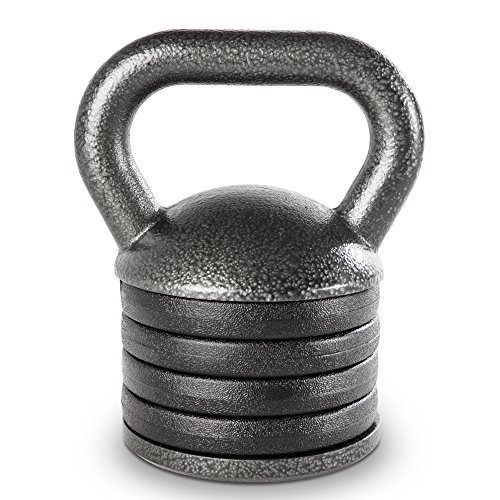
One handle instead of a shelf, but only if you already own 1-inch plates
Apex lists a 20 lb system: a 15 lb weighted handle, four non-weighted removable spacer disks, a 5 lb bottom plate and a centre pin, in cast iron with a powder-coated finish, loading to 50 lb.
Price as of
Apex lists a 20 lb system: a 15 lb weighted handle, four non-weighted removable spacer disks, a 5 lb bottom plate and a centre pin, in cast iron with a powder-coated finish, loading to 50 lb. Read the constraint before you buy, because it decides everything: 1-inch standard plates only, not 2-inch Olympic plates. If you do not already own 1-inch plates this is not cheaper than two cast bells, and the loaded stack changes the balance as you add weight. $45.59 as of October 2026.

A 35 lb bell for apartments and floors you are not allowed to damage
This is not cast iron.
Price as of
This is not cast iron. Yaheetech describes a durable HDPE plastic coating filled with cement, made by an integral mould unloading process intended to avoid seam cracks, with a textured handle for sweaty hands. The maker says it will not do as much floor damage when dropped compared with iron models. At $49.99 as of October 2026 it is about $1.43 per pound. The honest limitation: a filled shell and a single casting fail differently, and we found no published durability test of either.
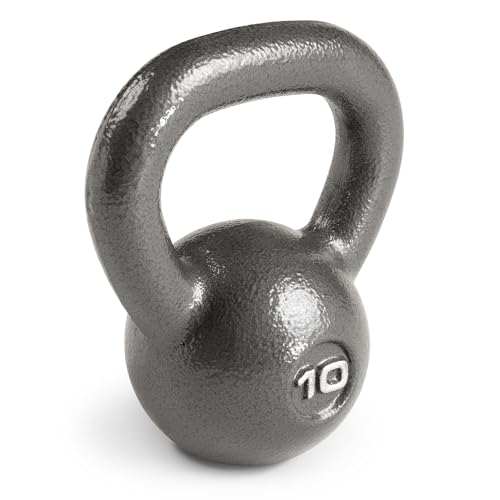
The lightest sensible bell, for a deconditioned or returning start
Ten pounds of cast iron with a non-rust hammertone coating for $15.
Price as of
Ten pounds of cast iron with a non-rust hammertone coating for $15.99 as of October 2026, about $1.60 per pound. Marcy says each piece is cast to a precise weight, that the line runs from 10 through 55 lb so you can progress without changing brands, and that it carries a limited two-year manufacturer guarantee. At 10 lb (4.5 kg) it matches the lightest bell used in any kettlebell trial we cite, so treat it as a pressing and get-up bell rather than your only bell.
Our top three, ranked
The Leaderboard
If you are only going to own one bell, own this weight
The weight most beginner swing programmes are written around, in the construction we would choose.
Check PricePrice as of
The cheapest honest way to find out whether you will keep training
Fifteen pounds of cast iron in a vinyl jacket for $18.
Check PricePrice as of
For the lifts a 16 kg bell makes unlearnable
A 12 lb technique bell for pressing and get-ups.
Check PricePrice as of
What to know before you buy
Field Notes
What size kettlebell should a beginner buy?
No trial has compared beginner starting weights, so every number in this category is a convention rather than a finding. Two conventions are citable. The 2019 scoping review by [Meigh and colleagues in BMC Sports Science, Medicine and Rehabilitation](https://pmc.ncbi.nlm.nih.gov/articles/PMC6719359/) mapped 99 publications and records that kettlebell sport uses bells "most commonly available from 8 kg to 32 kg in 2-4 kg increments", while faulting its own evidence base for participants being "largely under-dosed in experimental conditions". The [2025 competition rules of the International Union of Kettlebell Lifting](https://www.ffforce.fr/medias/fichiers/Saison%202025/KETTLEBELL/Arbitrage/r%C3%A8glement%20iukl%202025.pdf) run the sport on 8, 12, 16, 24 and 32 kg bells, with 16 kg the bell for boys under 16 and 8 kg for the oldest women's categories. Our judgement rather than a published result: a 16 kg bell for swings plus a 10 to 12 lb bell for presses covers a beginner's first three months better than any single weight.
Is cast iron or a vinyl coated kettlebell better?
We found no published durability or grip comparison between coatings, and we are not going to invent one. What can be said is what the makers claim and what the geometry does. CAP says the vinyl on its 15 lb bell reduces wear and protects floors compared with uncoated cast iron; Amazon says the vinyl on its own bell protects floors, reduces noise and prevents corrosion. Both are cast iron underneath. The one grip figure we can cite is about handle size, not coating: [Kong and Lowe, in the International Journal of Industrial Ergonomics and indexed by NIOSH](https://stacks.cdc.gov/view/cdc/197408), put the optimal cylindrical handle diameter for grip force at "19.7% of the user's hand length", with 30 to 40 mm handles rated most comfortable for maximum exertions. A vinyl jacket adds diameter, which moves a handle up that range. Our preference is powder coat for a garage, vinyl for a bedroom floor, and that is editorial judgement.
Can one kettlebell actually make you stronger?
On some measures, in some populations, by modest amounts. The 2011 randomized controlled trial by [Jay and colleagues in the Scandinavian Journal of Work, Environment and Health](https://www.sjweh.fi/article/3136) put 40 adults through ballistic full-body kettlebell exercise three times a week for eight weeks and reported neck and shoulder pain intensity down 2.1 points and low back pain down 1.4 points against control, with trunk extensor strength increased. It also reported that "aerobic fitness remained unchanged". The [BELL pragmatic controlled trial by Meigh and colleagues in BMC Geriatrics](https://pmc.ncbi.nlm.nih.gov/articles/PMC9026020/) measured grip strength gains of 7.1 kg in the right hand and 6.3 kg in the left across its training phase, at 91.5% attendance. Both samples are small, and the BELL authors flag their single-cohort repeated-measures design and the chance that some of their many secondary findings are false positives.
Are kettlebell swings safe for a beginner?
The published record is reassuring and thin at the same time. The scoping review by [Meigh and colleagues](https://pmc.ncbi.nlm.nih.gov/articles/PMC6719359/) reports that no adverse events had been reported during kettlebell clinical trials and that no clear or quantifiable risk of harm from kettlebell training had been identified, while also concluding that the available longitudinal studies were "largely underpowered and of low methodological quality". The same authors caution that "it is unclear if the absence of reported adverse events is a true representation of kettlebell training or a limitation in reporting", so read that clean record as thin data rather than a safety guarantee. The later [BELL trial](https://pmc.ncbi.nlm.nih.gov/articles/PMC9026020/) in adults aged 59 to 79 did record four non-serious adverse events across its programme. Supervision is the common thread: both datasets come from coached sessions. If you have a history of back or shoulder problems, are pregnant, or have never performed a loaded hip hinge, get your technique looked at by a physiotherapist or qualified coach before you add speed.
Who put in the work
The Coach
Your Coach
Darlene Schmitt
I am a fitness instructor and promoter who truly enjoys helping others become the best they can be! My mission is to help people find the love of fitness and to help them develop a lifelong habit of exercise. I am a firm believer that fitness should be fun, and I make it my mission to ensure that my classes are always enjoyable. I am also a certified nutritionist and personal trainer, so I am able to offer my students comprehensive and well-rounded support.