How to foam roll: technique, timing and what it does not fix

Contains affiliate links. Our policy.
Roll slowly, spend 30 seconds to 2 minutes on each muscle group, and do it before or after training - both work, for slightly different reasons. Foam rolling buys you range of motion now and can take some edge off how sore you feel. What the evidence does not support is the idea that it breaks up scar tissue or lengthens your IT band. Exercise Legend is reader-supported: if you buy through the links below we may earn a commission, which never changes what we recommend.
The gap between what rolling changes and what people believe it changes is why most foam rolling advice is worse than none. It sends you to the floor for five minutes of grinding the side of your thigh, chasing a structural change the anatomy does not permit. The same distinction organizes our guide to the best muscle recovery tools: a tool that makes you feel better is not automatically one that makes you recover faster.
Foam rolling technique: slow, moderate pressure, and shorter than you think
Four things decide whether a session does anything.
Speed. This is the error almost everyone makes: people roll like they are flattening pastry. Cleveland Clinic's guide, which quotes exercise specialist Ben Kuharik, says to "slowly roll back and forth over the area." A physiotherapy clinic explainer is blunter about why: "rolling too quickly means you likely won't be able to target the deep tissue where tightness is really a problem." A couple of inches per second, not a blur.
Pressure. Cleveland Clinic's instruction is to "start out light - don't put your whole body weight into it right away", and to "adjust if you're sore from it the next day." You can always add load by stacking the other leg on top.
Breathing. Cleveland Clinic's instruction is to roll slowly and breathe "in through your nose, out of your mouth." If you are holding your breath, the pressure is too high for the position you are in.
Passes. Two to four slow passes along the muscle, pausing a few seconds on the spots that object. That is our working protocol rather than a published one, and the research gives us cover: the 2015 systematic review by Cheatham, Kolber, Cain and Lee in the International Journal of Sports Physical Therapy, covering 14 studies, concludes that "due to the heterogeneity of methods among studies, there currently is no consensus on the optimal SMR program."
How long to foam roll each muscle
30 seconds to 2 minutes per muscle group, and a whole-body session that runs about 10 minutes.
The lower end comes from the trials. In the studies Cheatham and colleagues reviewed, foam roller protocols "ranged from two to five sessions for 30 seconds to one minute", and they found that "short bouts of foam rolling (1 session for 30 seconds) or roller massage (1 session for 2 minutes) to the lower extremity prior to activity does not enhance or negatively affect muscle performance."
The upper end comes from clinical practice. Cleveland Clinic advises you to "spend about one to two minutes per muscle group or area where you're feeling sore or stiff", adds that "if you're just hitting one muscle area, you won't have to spend more than three minutes doing it", and says the whole thing "shouldn't take more than 10 minutes."
Note what is missing from both sources: a dose-response curve. Nobody has established that more is better, and we would not roll one muscle for ten minutes on the theory that it must beat five.
Five foam rolling positions worth knowing
These five cover the legs and the one part of the back that tolerates a roller.
- Quadriceps. Face down, forearms on the floor, roller under the front of one thigh. Work from just above the kneecap to the hip crease. Rotating the leg in or out moves the pressure to the inner and outer thigh.
- Hamstrings. Sit up with hands behind you, roller under one thigh, other foot on the floor. Roll from above the back of the knee to the sit bone. Stack the free leg on top when you want more pressure.
- Calves. Same seated setup, roller under one calf, working from just above the ankle to just below the knee. Turning the shin in and out reaches either side.
- Glutes. Sit on the roller, cross one ankle over the opposite knee, lean into the hip on the crossed side. Small movements, not long sweeps. Most people skip this one and most desk workers need it.
- Thoracic spine. Roller across the upper back, perpendicular to the spine, hands supporting the head, ribs down. Roll only between the bottom of the shoulder blades and the top of them, and stop at the bottom of your ribcage. This is the position that needs a long roller - a short one wobbles off to one side.
Foam rolling before or after a workout?
Both. The evidence is slightly better for before, which surprises people.
The most useful numbers come from the 2019 meta-analysis by Wiewelhove and colleagues in Frontiers in Physiology, pooling 21 studies and 454 subjects. Rolling before exercise produced small improvements in sprint performance (+0.7%, g = 0.28) and flexibility (+4.0%, g = 0.34), with negligible effects on jump (-1.9%, g = 0.09) and strength (+1.8%, g = 0.12). Rolling after exercise slightly blunted the usual post-exercise drop in sprint (+3.1%, g = 0.34) and strength (+3.9%, g = 0.21), and reduced muscle pain perception (+6.0%, g = 0.47).
The authors' own summary is the honest one: "the effects of foam rolling on performance and recovery are rather minor and partly negligible", but "evidence seems to justify the widespread use of foam rolling as a warm-up activity rather than a recovery tool."
That warm-up verdict matters because of what it rules out: rolling does not appear to cost you force the way a long static stretch can. If you want more hip range before a session of run training for Hyrox, two minutes on the quads and glutes is a cheap trade. The same review supplies the counterweight - "there are not enough high-quality and well-designed studies on FR to draw any definite conclusions."
After a session, you are managing a sensation. A 6% change in perceived muscle pain is real and it is also small, and it tells you nothing about tissue repair - the distinction we work through in what DOMS actually tells you.
What foam rolling does not fix
This is the section the rest of the internet leaves out.
It does not release your fascia
The term "self-myofascial release" is doing a lot of unearned work. A 2019 narrative review by Behm and Wilke in Sports Medicine concluded that "there is insufficient evidence to support that the primary mechanisms underlying rolling and other similar devices are the release of myofascial restrictions and thus the term 'self-myofascial release' devices is misleading." The same review notes that "rolling mechanisms underlying their effect on pain suppression are not well elucidated." Cheatham and colleagues reached the same place four years earlier: "the physiological mechanisms responsible for the reported findings in these studies are still unknown." The people who study this for a living do not claim to know exactly why it works.
The mechanism looks mostly neural
If rolling worked by mechanically remodeling the tissue under the roller, rolling your right leg could not change your left. It does. A 2023 scoping review by Konrad and colleagues in the European Journal of Applied Physiology found that "eight out of the nine individual studies investigating ROM measures reported a significant increase in ROM of the contralateral limb", averaging 5.60%. The explanation the reviewers favour is not mechanical. Summarising a study by Nakamura and colleagues, they report that "the increase in ROM of the contralateral ankle following FR was due to an increased tolerance of pain (i.e., higher tolerated torque during dorsiflexion), and not due to changes in muscle stiffness or spinal excitability", and conclude more broadly that contralateral gains "can likely be explained by changes in pain perception ... rather than changes in muscle structure, such as muscle stiffness."
Read that carefully. You are mostly changing what you are willing to move through, not what the tissue will permit.
It does not lengthen your IT band
The iliotibial band is the popular target and the worst candidate. Fairclough and colleagues, writing in the Journal of Anatomy in 2006, dissected the structure and reported that "the ITB was anchored to the distal femur by fibrous strands, associated with a layer of richly innervated and vascularized fat", and that "the ITB is simply a thickened, lateral part of the fascia lata." It is not a strap lying on top of your thigh. It is welded to the bone along its length.
The numbers match the anatomy. In a 2010 cadaver study by Falvey and colleagues in the Scandinavian Journal of Medicine and Science in Sports, strain gauges recorded that during standard stretching maneuvers "TFL/ITB junction displacement was 2.0+/-1.6 mm and mean ITB lengthening was less than 0.5%." The authors conclude that their "results challenge the reasoning behind a number of accepted means of treating ITBS."
So: rolling the outside of your thigh may reduce how tight the area feels. It is not lengthening the band. Those are two different claims and most articles blur them.
It does not flush out lactic acid
Nothing does, because there is no lactic acid there to flush. Exercise physiologists Robert Robergs and Samuel Torrens of Queensland University of Technology wrote in The Conversation in January 2024 that "we've known for decades that lactic acid has nothing to do with muscle soreness after exercise." The soreness comes from elsewhere: "if you exercise beyond your usual level or routine, you can cause microscopic damage to your muscles and their connections to tendons. Such damage causes the release of ions and other molecules from the muscles, causing localised swelling and stimulation of nerve endings."
If a roller is sold to you on lactate clearance, trust the rest of the copy less, not more.
Where not to roll
Five places to be careful.
- Your lower back. The lumbar spine has no ribcage to spread the load and nothing to stop it arching over the roller. The physiotherapy explainer above states it directly: "placing a foam roller beneath your lumbar spine (your lower back) or neck can cause strain and hyperextension." Roll the glutes and thoracic spine instead, which is usually what a stiff-feeling low back wanted anyway.
- The front of your neck. Same source, same reason, and no version of it worth attempting.
- Directly on a joint. Cleveland Clinic advises you to "be careful about using a foam roller on joints like your ankles, knees or elbows, as it can cause you to hyperextend those areas." Roll the muscle belly, stop short of the joint.
- An acute injury. Cleveland Clinic tells readers with "a broken bone or a torn muscle" to speak with a doctor first, and pregnant readers to "talk to your healthcare provider first."
- A spot that will not give. Hammering the same tender inch for three minutes is the classic mistake. The physiotherapy explainer again: "if a knot doesn't seem to be releasing, continuing to work on it will likely just cause more soreness."
One plain caveat: if you have a known injury, a circulatory condition or clotting risk, nerve damage or neuropathy, or you are pregnant, ask a clinician whether sustained deep pressure suits you before you start. That extends Cleveland Clinic's published cautions to conditions its page does not name, so treat it as our caution rather than their guidance. And if load is what hurts - the question we take up in is rucking bad for your knees and back - a roller treats the symptom, not the cause.
Which foam roller should you buy?
Two specs matter and neither is exciting.
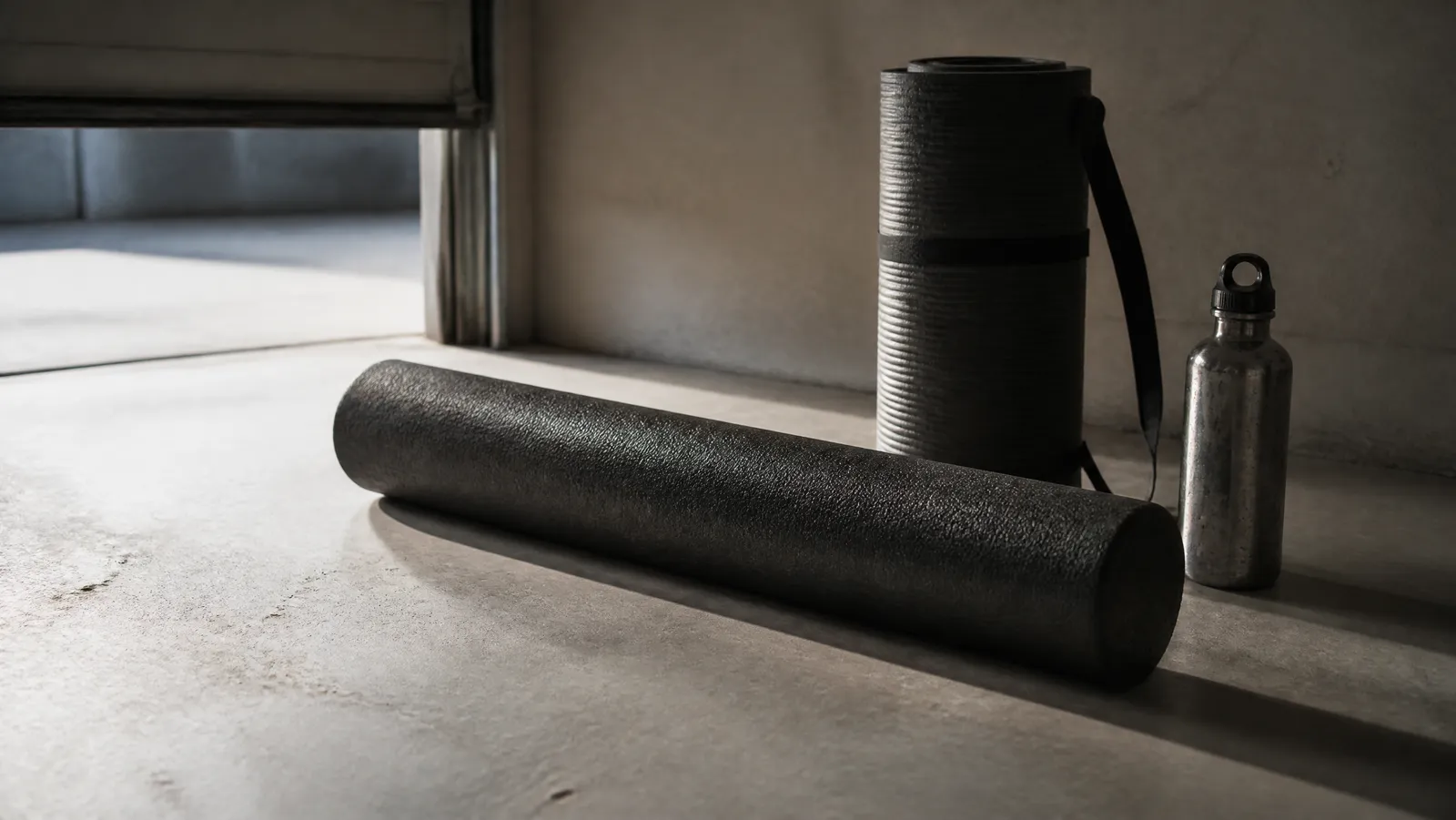
Density decides how much pressure you get at a given body weight. Firmer is not better, it is just more, and new users routinely buy something too firm and then avoid using it. Length decides what you can reach: a short roller does the legs fine, but only a long one lets you lie along your spine rather than across it.
One thing worth saying once, plainly: every spec below comes from the manufacturer's own listing. Nobody independently audits foam density or weight ratings in this market, so read them as marketing copy with numbers in it.
Around $13 - find out whether rolling does anything for you. The ProsourceFit is a 12 x 6 inch high-density roller in water-resistant expanded polypropylene, with a manufacturer-listed 300 lb maximum weight capacity. The listing is honest about the trade: the high density delivers deep pressure, but "new users may be sensitive." At $12.99 as of September 2026, it is the cheapest way to learn whether you are a person who rolls, and it comes in 36, 24, 18 and 12 inch lengths. Check the current price on Amazon.
Around $21 - the one that does your upper back. The Amazon Basics 36-inch is the full-length option: firm polypropylene with molded edges, lightweight, wipes clean. The reason to buy it is the thoracic position above, which a 12-inch roller cannot hold steady. At $21.41 as of September 2026 it is the one we would pick if we were only buying one, because it does the legs as well as the short roller and the back far better. Check the current price on Amazon.
Around $40 - varied pressure on one roller. The TriggerPoint Grid 1.0 is a 13-inch multi-density roller: EVA foam over a hollow core, with a three-dimensional ridged surface the manufacturer calls "Distrodensity Zones" that "replicate the feeling of a massage therapist's hands." The benefit is real - moving a few inches along the roller changes the pressure, so you can back off a tender spot without getting off the floor - and the manufacturer says it is firmer than traditional rollers and holds its shape with use. Its marketing also claims effects on "tissue aeration" and the "flow of blood and oxygen", which we have seen no independent evidence for and do not repeat. At $39.95 as of September 2026 you are paying about three times the budget pick for surface texture and durability: a reasonable buy for someone who already rolls, a bad first purchase. Check the current price on Amazon.
The other way to do a similar job is a percussion device, which reaches the same muscles without the floor positions. We compare them directly in massage gun versus foam roller, we went through the evidence for the devices in are massage guns worth it, and the technique is its own subject in how to use a massage gun properly. Our position in short: the roller is cheaper, the device is easier to actually pick up, and adherence beats specification.
The bottom line
Foam rolling is a cheap tool with a modest, real, well-documented effect and an enormous amount of nonsense attached to it. Roll slowly. Give each muscle group 30 seconds to 2 minutes. Use it before training if you want range of motion, after training if you want to feel less sore, and understand that the second is a change in sensation rather than a change in repair. Skip the lumbar spine, the neck and the joints, and stop grinding the spot that will not release.
Do not expect it to break adhesions, lengthen the IT band or clear lactate. The evidence does not support any of those, and the honest mechanism - a change in what you tolerate rather than what your tissue permits - is interesting enough without the invented biology.
If you are assembling a recovery setup rather than buying one item, start with our complete recovery tool guide and spend from there. A $13 roller is the lowest-risk purchase in the whole category.
Gear we'd put on our own floor
The Picks

If you want to find out whether rolling does anything for you
Twelve inches of high-density EPP for the price of two coffees.
Price as of
Twelve inches of high-density EPP for the price of two coffees. Short enough to travel, firm enough that you will not wonder whether you are pressing hard enough.

If you want to roll your upper back properly
The full-length roller is the one that lets you lie along your spine rather than across it, which is the difference between thoracic extension work and guesswork.
Price as of
The full-length roller is the one that lets you lie along your spine rather than across it, which is the difference between thoracic extension work and guesswork.

If you want varied pressure without buying three rollers
The ridged surface gives you several pressures on one roller, so you can back off a tender spot by moving a few inches rather than getting off the floor.
Price as of
The ridged surface gives you several pressures on one roller, so you can back off a tender spot by moving a few inches rather than getting off the floor.
How the picks stack up
Head To Head
If you want to find out whether rolling does anything for you
Twelve inches of high-density EPP for the price of two coffees.
Check PricePrice as of
If you want to roll your upper back properly
The full-length roller is the one that lets you lie along your spine rather than across it, which is the difference between thoracic extension work and guesswork.
Check PricePrice as of
If you want varied pressure without buying three rollers
The ridged surface gives you several pressures on one roller, so you can back off a tender spot by moving a few inches rather than getting off the floor.
Check PricePrice as of
What to know before you buy
Field Notes
Can foam rolling replace stretching?
For range of motion, the two look closer than either camp admits. The 2022 meta-analysis by Konrad, Nakamura, Tilp, Donti and Behm in [Sports Medicine](https://pmc.ncbi.nlm.nih.gov/articles/PMC9474417/) pooled three studies that compared the methods head to head and found "no significant difference between stretching and foam rolling exists" (p = 0.12), while noting that static stretching may be more effective for ankle range specifically. Three comparisons is a thin base, and the authors do not present it as settled. Our reading is that you should do whichever one you will actually do, and that rolling has the practical edge of being tolerable when a muscle is too sore to stretch. That preference is our judgement, not a finding.
Why does rolling my calves not seem to help my ankles?
Because that is the one site where the training evidence comes up empty. The same 2022 [Sports Medicine](https://pmc.ncbi.nlm.nih.gov/articles/PMC9474417/) meta-analysis reports that "foam rolling increased joint ROM when applied to hamstrings and quadriceps, while no improvement in ankle dorsiflexion was observed when foam rolling was applied to triceps surae." That is a result about multi-week training programs, not about how your ankle feels ten minutes after rolling, and the review is built on 11 studies and 290 participants. If stiff ankles are the thing limiting your squat depth, the honest advice is that a roller is not the highest-yield tool you could pick up.
How often do I need to foam roll to get lasting flexibility?
More often and for longer than most people expect. The 2022 meta-analysis in [Sports Medicine](https://pmc.ncbi.nlm.nih.gov/articles/PMC9474417/) found that foam-rolling training "can increase joint ROM in young healthy participants" with a moderate effect (ES = 0.823, p = 0.001), but that "longer duration interventions (greater than 4 weeks) are needed to induce ROM gains" - programs of four weeks or less did not reach significance (p = 0.326). The included studies applied rolling roughly one to three times a week over three to eight weeks. The acute mobility you feel after a single session and the flexibility you keep are two different purchases.
Should foam rolling hurt?
It should be uncomfortable, not sharp, and you should be able to breathe through it. [Cleveland Clinic's guide](https://health.clevelandclinic.org/foam-rolling) advises you to "start out light - don't put your whole body weight into it right away" and to "adjust if you're sore from it the next day." Grinding harder on a spot that will not give is the most common mistake we see. A [physiotherapy clinic explainer](https://www.sussexphysiopilates.co.uk/blog/7/8/2017/6-foam-rolling-mistakes-you-keep-making-and-how-to-fix-them) puts it plainly: "if a knot doesn't seem to be releasing, continuing to work on it will likely just cause more soreness." Move on, come back tomorrow, and get a clinician involved if a spot keeps hurting.
Who put in the work
The Coach
Your Coach
Darlene Schmitt
I am a fitness instructor and promoter who truly enjoys helping others become the best they can be! My mission is to help people find the love of fitness and to help them develop a lifelong habit of exercise. I am a firm believer that fitness should be fun, and I make it my mission to ensure that my classes are always enjoyable. I am also a certified nutritionist and personal trainer, so I am able to offer my students comprehensive and well-rounded support.