Best recovery tools for runners and ruckers: our picks

Contains affiliate links. Our policy.
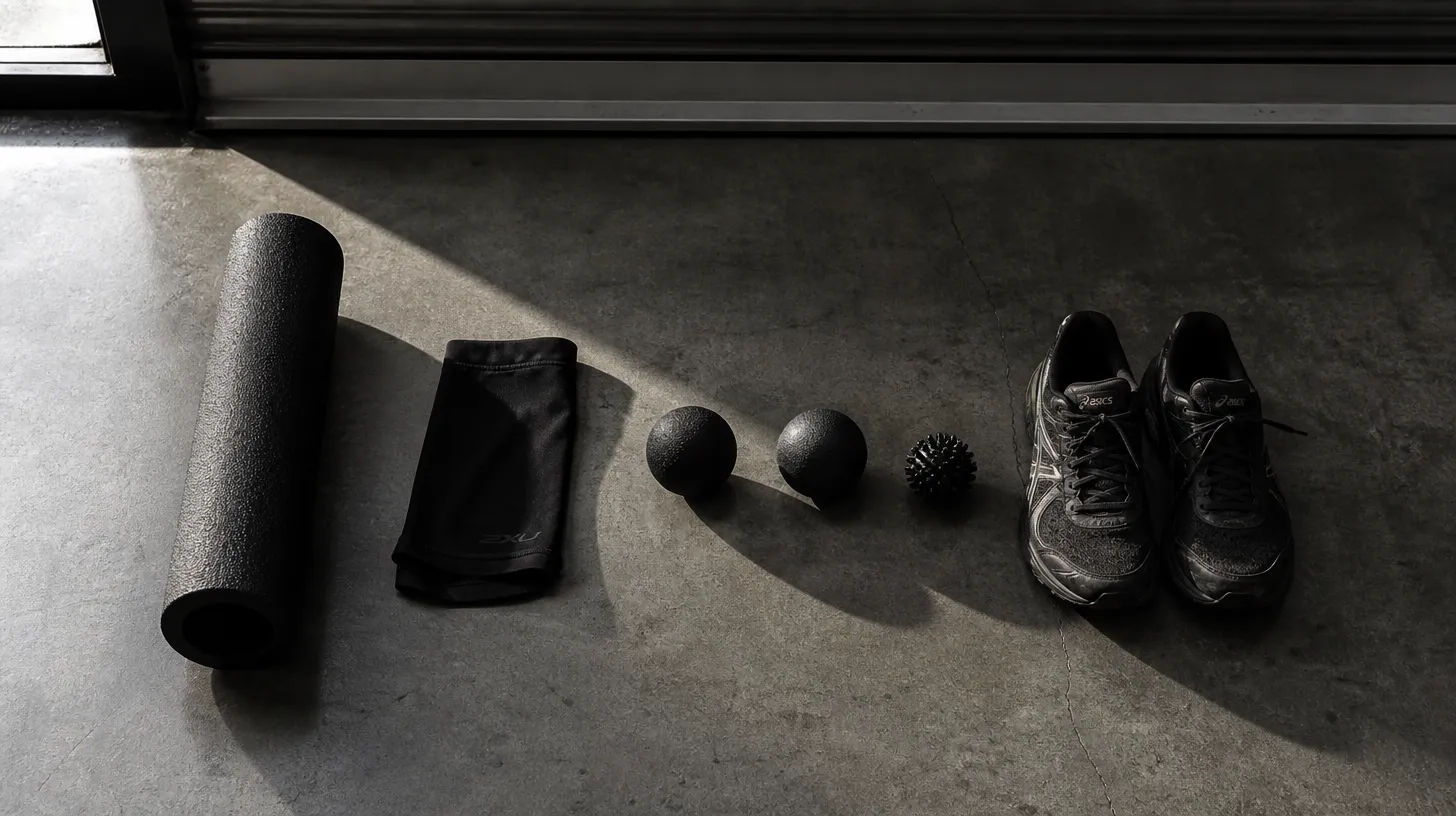
The best muscle recovery tools for runners are the cheap ones, and they are cheap because the tissues that need them are small. Our shelf is a $5.88 ball for the feet, a $7.99 pair of lacrosse balls and a $14.99 pair of calf sleeves — about $29 as of September 2026 — with a roller added when you want to cover a whole leg in ten minutes. Exercise Legend is reader-supported: if you buy through the links below we may earn a commission, which never changes what we recommend.
That is not the answer a general roundup gives, including our own guide to the best muscle recovery tools, which sorts the shelf for everyone who trains. Runners and ruckers are not everyone. You load the lower leg and the foot, plus, if you carry a pack, one region under the straps. Pick for those places and the list gets cheaper, not more expensive.
One promise up front, because it is the one every other roundup breaks: nothing here reliably makes you ready for tomorrow's session sooner. These tools change how your legs feel. That is worth money, and it is not the same thing.
What running and rucking actually beat up
The injury data is unusually clear about where to spend. A systematic review of running-related musculoskeletal injuries published in 2021 found that "the knee, ankle, and lower leg accounted for the highest proportion of injury incidence, whereas the knee, lower leg, and foot/toes had the highest proportion of injury prevalence." Overall injury incidence across the included studies came out at 40.2% and prevalence at 44.6%.
Break it down by diagnosis and the pattern is sharper. In the same review, Achilles tendinopathy accounted for 10.3% of injury incidence, medial tibial stress syndrome 9.4%, patellofemoral pain syndrome 6.3%, plantar fasciitis 6.1% and ankle sprains 5.8%. Four of the top five sit below the knee, and two of those four are the calf complex and the sole of the foot.
That is the shopping list. Not "legs". Specifically:
- Calves and the Achilles, which absorb and return load on every stride.
- The shins, where medial tibial stress syndrome lives.
- The plantar fascia and the small muscles of the foot, which a 13-inch cylinder cannot touch.
- Quads and glutes, which get sore but are rarely what stops you.
- The traps and upper back, for ruckers only, and only because of the straps.
A lifter's shelf is built around quads and glutes. Yours should be built around the first three, which changes what is worth buying.
What these tools do, and what they do not do
Every article in this series has landed in the same place. The measured effects of self-massage are on how a muscle feels, and they are small.
The 2019 meta-analysis by Wiewelhove and colleagues in Frontiers in Physiology pooled 21 foam-rolling studies. Rolling after exercise "reduced muscle pain perception (+6.0%, g = 0.47)" and slightly blunted the usual post-session drops in sprint (+3.1%) and strength (+3.9%) performance. Their conclusion is the sentence to remember: "Evidence seems to justify the widespread use of foam rolling as a warm-up activity rather than a recovery tool."
Read the outcome variable. Muscle pain perception is a rating on a scale. Lowering it means the leg feels better, a legitimate reason to own a $10 object. It is not the same claim as tissue repairing faster, and the length of your real recovery window is set by things a roller does not touch, as we lay out in how long muscle recovery takes.
So the honest pitch for everything below: it is cheap, it makes hard weeks more pleasant, and a couple of items have modest evidence for perceived soreness. That is enough. It does not need dressing up as a performance gain.
The roller: one good one, or one cheap one
For a runner, length matters more than features: a short roller is easier to control on one calf and fits in a suitcase.
Our pick is the TriggerPoint GRID 1.0 in the 13-inch size, $39.95 as of September 2026. The manufacturer lists a hollow core wrapped in EVA foam, which it says is firmer than a traditional solid roller and keeps its shape after repeated use, plus a multi-density surface of ridges and nodules it brands as Distrodensity Zones. Those are the maker's descriptions, not independent measurements. The same listing claims the roller "promotes the flow of blood and oxygen for optimal muscle recovery" and "replicates the feeling of a massage therapist's hands"; we are not repeating either as our own view. What we will say is that firmness is the variable runners notice.
The ProsourceFit 12-inch high-density roller is $10.99 as of September 2026 and does the same job less comfortably. The manufacturer lists high-density expanded polypropylene, a firm textured non-slip surface and an easy-clean finish, and sells the same line in 18-inch and 36-inch lengths. One warning: this listing covers more than one shape, and its own text is not consistent about which one you are getting. We will not tell you whether the unit that arrives is a full cylinder or a half-round, because the listing does not. If shape matters, check the variant before checking out.
Neither roller teaches you anything, and technique is most of the result. We cover that in how to foam roll.
Calves and shins: where the roller comes up empty
Here is the part a gear roundup skips: the tissue runners most want to fix is the one where rolling has the weakest record.
The 2022 systematic review and meta-analysis by Konrad and colleagues in Sports Medicine pooled 11 studies and 290 participants and found a moderate overall effect of foam-rolling training on range of motion, effect size 0.823. Broken out by muscle, though, "no improvement in ankle dorsiflexion was observed when foam rolling was applied to triceps surae" — effect size minus 0.024, which is nothing. Only interventions longer than four weeks produced gains at all, and the authors concluded that "responses are muscle or joint specific."
So if you want measurable calf and ankle range, the roller is not the tool with evidence behind it. If you want a calf that feels less like a cable, that is a more modest goal, and it is where a wrap-around roller earns its keep.
The Shadowfit muscle roller is $24.99 as of September 2026. The manufacturer describes four rollers on a flexible frame that wraps around a limb, marketed at runners, cyclists and swimmers, and says it targets legs, arms, neck, calves, shins and feet. Its claim that this relieves tension and stress from intense workouts is the maker's language, not a finding.
The reason we include it is boring: you can use it in a chair, with no floor work and no body weight to manage. After a long run that is the difference between doing something and nothing — our judgement about adherence, not a published protocol.
Feet: the best six dollars in recovery
Nothing else on this page reaches the sole of your foot, which is where 6.1% of running injury incidence lives, per the review above.
There is more support for working on it than you might expect. The 2023 heel pain clinical practice guideline from the Academy of Orthopaedic Physical Therapy and the American Academy of Sports Physical Therapy, published in JOSPT, advises clinicians to "use manual therapy directed at the joints and soft tissue structures of the lower extremity" to "decrease pain, and improve function in individuals with plantar heel pain." A 2025 review in Cureus adds that "stretching is one of the most effective conservative therapies for plantar fasciitis." Note what neither says: clinician-delivered manual therapy is not a ball on your kitchen floor.
The closest thing to a direct test is small. In a 2023 study in the International Journal of Environmental Research and Public Health, 36 participants worked each foot on a rigid rubber ball for three 30-second bouts, and the authors reported that "an SMR session of both feet was able to increase posterior muscular chain flexibility up to one hour after intervention." One session, 36 people, a flexibility outcome, an effect that lasts an hour. Useful before a run. Not a treatment.
The Due North Foot Rubz ball is $5.88 as of September 2026. The manufacturer describes a dense rubber ball with flat spikes placed so pressure adjusts without gouging a floor the way a hard spiky ball can, made in the USA and pocket sized. Its listing also markets it for plantar fasciitis and says it "relaxes muscles and increases circulation" — manufacturer copy, not our view, and a circulation claim is exactly the kind we decline across this site.
Our protocol, offered as judgement rather than a published one: barefoot and standing, 30 seconds each on the arch, the heel and the outside edge, both feet.
Compression sleeves are not compression boots
A calf sleeve is a garment applying passive graduated pressure. Pneumatic boots are a device that inflates and deflates in cycles, with their own and larger literature, which we go through in whether compression boots actually work. Do not read across from one to the other, in either direction.
The garment evidence is weak. The 2024 systematic review and meta-analysis by Franke, Hofstede, Van Den Broek and Huisstede in the International Journal of Exercise Science looked at lower leg compression garments specifically, across 23 studies all rated at high risk of bias. Their meta-analysis "showed no difference in effectiveness between CGs versus non-CGs (such as regular socks) and versus placebo CGs (low certainty evidence)", and they "identified no evidence for a beneficial or detrimental effect of lower leg CGs on the occurrence of lower extremity sports injuries, subjective ratings of fatigue, or biomechanical variables."
The counterweight is the wider garment literature. A 2014 meta-analysis by Hill and colleagues in the British Journal of Sports Medicine found a moderate benefit for recovery of soreness, strength, power and creatine kinase, largest beyond 24 hours, and concluded that compression garments "seem to moderately improve post-exercise recovery." That pooled full garments across body regions rather than calf sleeves in runners, so we treat Franke's narrower review as the better guide here.
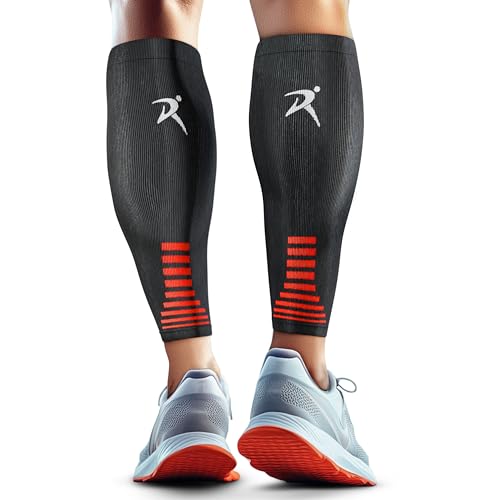
The Rymora calf compression sleeves are $14.99 a pair as of September 2026. Rymora lists a footless sleeve in 54% nylon, 39% polyester and 7% elastane, graduated compression, moisture-wicking and machine washable. It also states that the sleeves "help reduce muscle fatigue and stiffness" after exercise and that the compression "encourages circulation"; those are the maker's claims, and on the evidence above we are not endorsing them. Rymora sizes these by calf circumference rather than height, weight or clothing size, which is the one manufacturer instruction here worth following exactly.
Buy them because compression is comfortable under a pack and on a cool-down walk. Do not buy them expecting a faster Tuesday.
If you have a known injury, a circulatory condition or clotting risk, diabetes or neuropathy with reduced sensation in your feet, or you are pregnant, talk to a clinician before adding compression or sustained pressure to a leg. An international Delphi study on the contraindications and cautions of foam rolling reached consensus that deep vein thrombosis (97% agreement) and local tissue inflammation (97%) are cautions, and that open wounds (73%) and bone fractures (84%) are contraindications.
Two lacrosse balls for what a roller bridges over
Lay a 13-inch cylinder across a glute or the strap line of your traps and it spans the target instead of pressing it. A ball does not.
The Kieba massage lacrosse balls come as a set of two for $7.99 as of September 2026. The manufacturer lists 100% solid rubber at official lacrosse ball size and weight, with no chemical odor and no staining on walls. Claims about eliminating knots are the maker's, and "knots" is not a structure we would claim any tool acts on.
Two rather than one is the practical point: one either side of the spine, or one in the bag and one by the door. Start against a wall rather than the floor, which lets you control how much weight goes in. Our advice, not a protocol from a trial.
Ruckers: the strap line across your traps
Loaded walking moves the problem upward. Feet and calves still take the brunt as pack weight climbs, the way we describe in rucking vs walking, but the shoulders become their own complaint — a pressure problem rather than a soreness problem.
A 2015 study by Wettenschwiler and colleagues in PLOS One put 10 men in a backpack at 15, 20 and 25 kg across 12 configurations and found that static peak pressure accounted for "85% or more of the variation in discomfort". It also found that "the hip region is significantly more tolerant than the shoulder region", needing more than twice the shoulder's peak pressure for the same discomfort.
Two consequences, and only one is a purchase. First, the fix is load transfer: weight off the shoulders and onto the hips, a fit question we take up in best weighted vest for rucking. Second, the tissue that gets sore under the straps is the upper back and traps, and the tool for that is a ball against a wall, not a roller. Ruckers should reorder our list: balls first, then feet, then compression.
What we left out, and why
Massage guns. Not because they are bad. Percussion has a comparable evidence base to rolling and wins on reach and effort, which is why it gets its own treatment in are massage guns worth it and a head-to-head in massage gun vs foam roller.
Cold plunges and ice baths. A different intervention with its own literature and its own article this week: ice bath vs cold plunge. A tub also does not fit in a gym bag.
Pneumatic compression boots. Covered in whether compression boots actually work, and left off on price rather than principle. They cost many times everything on this page, and the reported effect does not scale with the invoice. Our judgement, and the one call here we would revisit if prices fell.
Anything sold as flushing lactic acid. Soreness is not a lactic acid problem, as we set out in is muscle soreness good, so a tool sold on that mechanism is sold on one that does not exist.
The order we would buy them in
This is our judgement, not a published protocol. It is sequenced by cost per unit of relief, not by which item we like most.
First, under $20 total. The foot ball and the pair of lacrosse balls, $13.87 together as of September 2026. Between them they cover the plantar fascia, the glutes and the strap line — most of what a runner or rucker wants pressed.
Second, when weekly volume climbs. The calf sleeves, taking the total to about $29. Buy them as comfort. If your legs feel less heavy after a long effort, that is the whole return, and it is a real one.
Third, if you will actually get on the floor. A roller. The $10.99 ProsourceFit if you are unsure, the $39.95 TriggerPoint if you already roll two or three times a week. The cheap one costs eleven dollars to find out; the expensive one, forty.
Fourth, only if the floor is the obstacle. The wrap-around limb roller. Twenty-five dollars for a tool whose advantage is that you will use it in a chair looks odd on paper and works in practice.
What we would skip. Vibrating rollers, heated rollers, anything with an app, and boots at this budget. Also a second roller. Nobody needs two.
The bottom line
Run or ruck and your recovery problem lives below the knee, with a strap-shaped exception across the top of your back. It is one of the few gear questions where the right answer is cheap: about $29 covers the feet, the glutes and the calves, and a roller under $15 covers the rest. What none of it reliably does is shorten the recovery window, and anything sold on that basis is sold beyond the evidence.
If you want the wider picture — which categories have real support and which are priced on hope — start with our complete recovery tool guide. And if you are here because a rising mileage block has wrecked your calves, the tool that helps most is not on this page at all. It is the schedule, which is the argument we make in run training for Hyrox.
Gear we'd put on our own floor
The Picks

If you are only going to own one roller, own a short firm one
Thirteen inches is the right length for calves, quads and glutes, and the maker says the hollow core wrapped in EVA foam is firmer than a traditional solid cylinder, which matters once a calf stops responding to soft foam.
Price as of
Thirteen inches is the right length for calves, quads and glutes, and the maker says the hollow core wrapped in EVA foam is firmer than a traditional solid cylinder, which matters once a calf stops responding to soft foam. The honest limitation is that it costs roughly four times the budget pick and the evidence does not say it works four times better.

If you want to find out whether you will actually use a roller
A firm, high-density expanded polypropylene roller with a textured non-slip surface, and the cheapest way to discover whether rolling is a habit you will keep.
Price as of
A firm, high-density expanded polypropylene roller with a textured non-slip surface, and the cheapest way to discover whether rolling is a habit you will keep. One caution: this listing is sold in more than one shape and length, so check the variant you are adding to the cart before you buy.

If your calves and shins are the part that always complains
Four rollers on a flexible frame that wraps around a limb, so you can work a calf sitting in a chair instead of hauling yourself onto the floor.
Price as of
Four rollers on a flexible frame that wraps around a limb, so you can work a calf sitting in a chair instead of hauling yourself onto the floor. It buys reach and comfort rather than a documented recovery effect, and we would not pretend otherwise.

If you buy one thing off this page, buy this
A pocket-sized dense rubber ball with flat spikes, which is the cheapest route to the one tissue a foam roller cannot reach at all.
Price as of
A pocket-sized dense rubber ball with flat spikes, which is the cheapest route to the one tissue a foam roller cannot reach at all. It is small enough to live in a gym bag and cheap enough that losing one is not an event. It does nothing for a calf.
If you want your legs to feel less heavy on the drive home
A footless graduated-compression calf sleeve sold as a pair, in a nylon and polyester blend with a little elastane.
Price as of
A footless graduated-compression calf sleeve sold as a pair, in a nylon and polyester blend with a little elastane. Buy it for comfort, not for recovery: the pooled evidence on lower-leg compression garments is weak, and the maker sizes these by calf circumference rather than shoe or clothing size, so measure first.

If you need pressure somewhere a roller bridges straight over
Two solid rubber balls at official lacrosse size and weight, which is the standard tool for glutes, the muscles alongside the spine and the strap line across a rucker's traps.
Price as of
Two solid rubber balls at official lacrosse size and weight, which is the standard tool for glutes, the muscles alongside the spine and the strap line across a rucker's traps. Firm enough that we would start against a wall rather than on the floor.
Our top three, ranked
The Leaderboard
If you are only going to own one roller, own a short firm one
Thirteen inches is the right length for calves, quads and glutes, and the maker says the hollow core wrapped in EVA foam is firmer than a traditional solid cylinder, which matters once a calf stops responding to soft foam.
Check PricePrice as of
If you want to find out whether you will actually use a roller
A firm, high-density expanded polypropylene roller with a textured non-slip surface, and the cheapest way to discover whether rolling is a habit you will keep.
Check PricePrice as of
If your calves and shins are the part that always complains
Four rollers on a flexible frame that wraps around a limb, so you can work a calf sitting in a chair instead of hauling yourself onto the floor.
Check PricePrice as of
What to know before you buy
Field Notes
Should I foam roll before a run or after it?
Before, if you are picking one. The 2019 meta-analysis by [Wiewelhove and colleagues in Frontiers in Physiology](https://www.frontiersin.org/journals/physiology/articles/10.3389/fphys.2019.00376/full) pooled 21 studies and found that rolling beforehand produced small improvements in sprint performance (+0.7%) and flexibility (+4.0%), and that rolling afterwards slightly blunted the usual post-exercise drop in sprint (+3.1%) and strength (+3.9%) while reducing muscle pain perception (+6.0%). Their own summary is blunter than most product marketing: "evidence seems to justify the widespread use of foam rolling as a warm-up activity rather than a recovery tool." Neither effect is large. Roll before a session if you want range of motion, after if you want to feel less beaten up.
Do calf compression sleeves prevent shin splints or calf strains?
Nobody has tested it properly, which is not the same as a yes. The 2024 systematic review and meta-analysis by [Franke, Hofstede, Van Den Broek and Huisstede in the International Journal of Exercise Science](https://pmc.ncbi.nlm.nih.gov/articles/PMC11042856/) looked specifically for that answer across 23 studies and reported that "no studies focused on the effect of CGs on the incidence of lower extremity sports injuries in athletes." On the outcomes that had been measured, their meta-analysis "showed no difference in effectiveness between CGs versus non-CGs (such as regular socks) and versus placebo CGs (low certainty evidence)." Our judgement, not a finding: wear them because they are comfortable under a loaded pack, and manage shin pain by managing your weekly mileage.
How long should I roll a ball under my foot?
Three minutes total is a defensible dose because it is the one that has been measured. In a 2023 study in the [International Journal of Environmental Research and Public Health](https://pmc.ncbi.nlm.nih.gov/articles/PMC9858880/), Russo and colleagues had 36 participants stand on a rigid rubber ball roughly 7 cm across and work each foot for three 30-second bouts, and found that "an SMR session of both feet was able to increase posterior muscular chain flexibility up to one hour after intervention." Two details keep it honest: the outcome was a sit-and-reach score rather than soreness or repair, and the already-flexible subgroup showed no significant improvement at all.
Is it safe to use a roller or massage ball if I have vein problems?
Ask a clinician first, and the experts agree on that more than they agree on almost anything else in this field. An [international Delphi study on the contraindications and cautions of foam rolling](https://pmc.ncbi.nlm.nih.gov/articles/PMC8622134/) found consensus that deep vein thrombosis (97% agreement) and local tissue inflammation (97%) should be treated as cautions, and that open wounds (73%) and bone fractures (84%) are contraindications. That list is about foam rolling specifically, and we would apply the same caution to a ball, a limb roller or a compression sleeve, since all three put sustained pressure on a limb. That extension is our judgement rather than part of the published consensus.
Who put in the work
The Coach
Your Coach
Darlene Schmitt
I am a fitness instructor and promoter who truly enjoys helping others become the best they can be! My mission is to help people find the love of fitness and to help them develop a lifelong habit of exercise. I am a firm believer that fitness should be fun, and I make it my mission to ensure that my classes are always enjoyable. I am also a certified nutritionist and personal trainer, so I am able to offer my students comprehensive and well-rounded support.